Monday, April 6, 2015

A Peace Corps - Panama Passover

I will tell most of this post through pictures and limericks.  It's better that way, right?!

To provide a bit of context – I grew up celebrating both Passover and Easter, both with much merriment, and remember the traditions – both prescribed, and what my family invented – fondly.  Although honey-baked ham and matzah are not readily available in most parts of Panamá, I wanted to have some kind of celebration anyway – and invite other volunteers who might be missing out on their own traditions back home, as well as include my community in this sharing of culture.

So I invited all the Peace Corps Volunteers and a few of my community members to join me for a Passover Seder Potluck at my house.  It was intended to be a mix of traditions, so everyone was allowed to bring absolutely whatever food they wanted – no Passover or Holy Week or any other rules.

To be as inclusive – and entertaining – as possible, we also did a Scavenger Hunt during the afternoon – which was more or less an Easter Egg Hunt, since you searched all over the place for items and the winners got the best and/or most candy at the end.  We split into two teams, and each team had guides from the community to help them find the items, which were worth different amounts of points based on how difficult or far away they would be to find.  It was a wonderful opportunity to show off my community – which gave my fellow Volunteers a neat glimpse at the coolest things in Quebrada Pastor and gave the members of Quebrada Pastor an opportunity to show around visitors.  Everyone – guides, Volunteers, and others in the community who participated as subjects of the Scavenger Hunt – had tons of fun.

The Passover Seder was abridged to about half an hour, following a Haggadah that I invented especially for the occasion – the text is below – with some explanations in Spanish to include my community friends.  It was intended to be completely irreverent – substituting Peace Corps experiences for the actual details of the Exodus – yet still recognize the traditions and teach a little bit about the Passover holiday.  Again, both Volunteers – some who had attended Seders in the past, others who hadn't – and community members alike, found it entertaining and interesting.

And of course the food was well-enjoyed!

Pictures:

From the Scavenger Hunt, some of the items on the list:

These are from Willy's group, photos taken by James:

Nagua (Expert level, 50 points) – Very few people wear naguas in Quebrada Pastor)


Cacao pod (Easy level, 5 points) – We live in a Chocolate Forest! Cacao pods are everywhere!


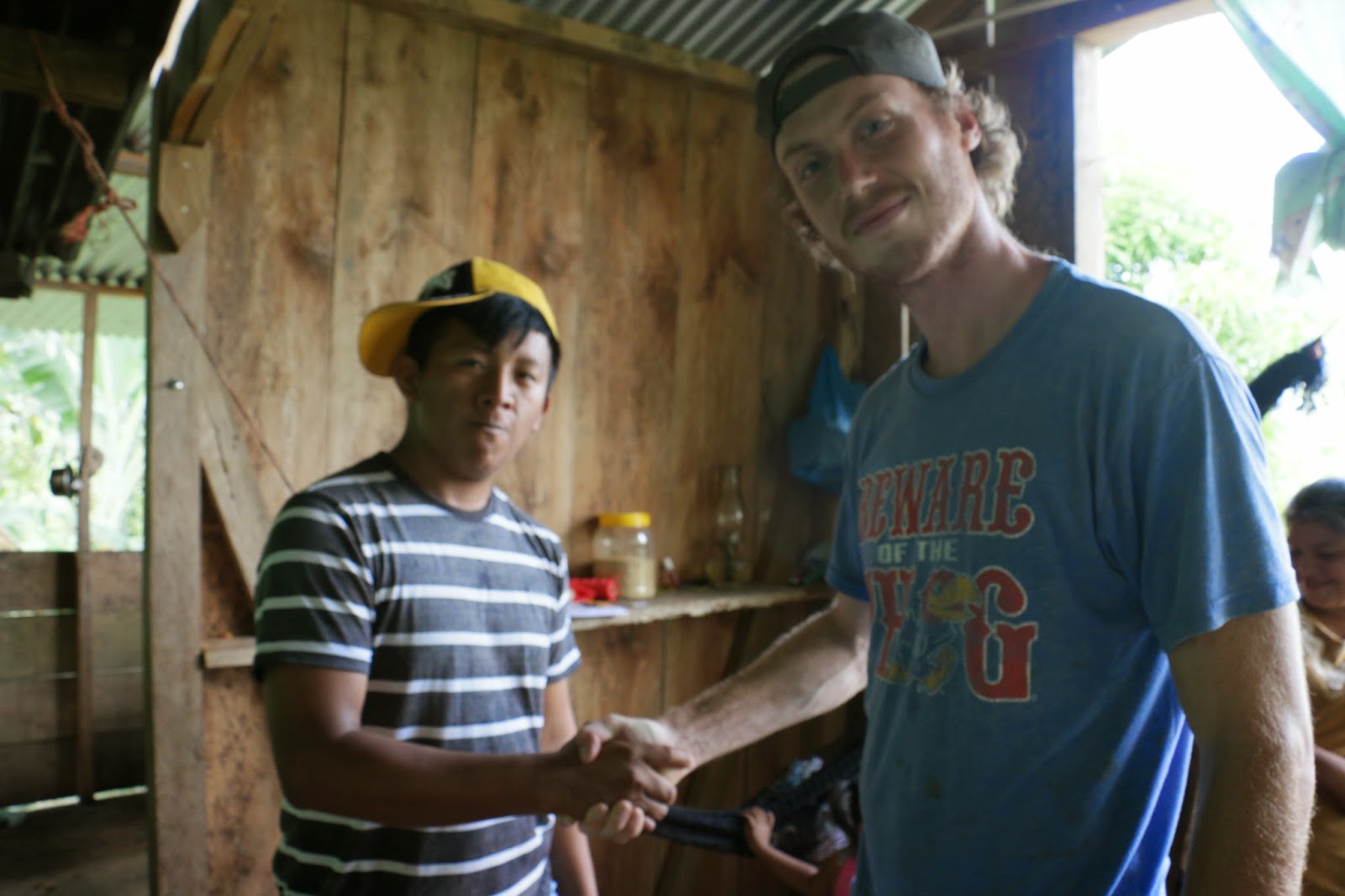
A firm handshake (Hard level, 20 points) – Firm handshakes are not the custom in most Ngobe communities

3-person pyramid (Bonus, 2 points)


Composting latrine (Easy level, 5 points) – This one happens to be Jose's, the composting latrine champion of Quebrada Pastor


Hugging a tree (Bonus, 2 points)


Baby in a mochila (Hard, 20 points) – Mochilas are often used as cradles, just like hammocks


These are from following around Nayelis and Lidianeth's group:

Taking a picture of the view of Bocas town (Hard level, 20 points)


The whole team with their guides


The long hike up the hill


View from the top


A nagua, which Dylan modeled for us


Smiling children (Easy level, 5 points)


Whoa, a 6-person pyramid!  Overachievers!


And after the Scavenger Hunt, we got read for the Passover portion of the day... a potluck Seder!  (More emphasis on the potluck than the Seder...)

Getting ready for Seder and dinner


All the food for the potluck! My contributions were Charoset (my favorite item on the Seder plate) and Glorified Rice (a classic holiday dish on Mom's side of the family – looks like dessert but is always served with dinner)


Willy and Mechi enjoying Abby's caramel popcorn


The morning after – we all survived! – with the coconut palm frond decorations that Willy taught me to make


No time to rest!  Back to work!

Determining the order of Ferrocement Tank construction during the second training session


There it is! All photos from building my tank.


Gatita del Diablo!  Devil Kitten!


Willy made a drawing...


This is the only time you'll ever find me in traditional Panamanian holiday costume...


And this is what we used to perform our Seder -- it more or less follows the order and the intent of the Seder, while paying respect to the Peace Corps Panama experience...

The Haggadah: Abridged, Irreverent, and in Limerick form
Alex Litofsky, 2015

This holiday sure is a winner
Even if you are a beginner.
You'll agree, I think:
We're requir'd to drink
Four glasses of wine before dinner.

This story has been told many times,
In Hebrew, other tongues, now in rhymes.
Strangers in a strange land –
Here, we all understand –
Slaves to our work that we are sometimes.

We've all had cultural confusion,
And to offer complete inclusion,
This Seder's most right
With details not quite,
But makes a Passover allusion.

Candles

Since “No hay luz,” beginning the night,
Our first blessing is, “Thank you for light.”
Candles there are not,
They could not be bought.
“Prestame foco,” just sounds more right.

Shehecheyanu – Wine

We have indeed all made it alive,
Now glass of wine to drink as we thrive.
Thankful for this food,
I'll toast that: “Salud!”
Hope the parasites did not survive.

Throughout this dinner symbols abound,
Most of them on this plate can be found.
To be not much delayed,
So that hanger is stayed,
Briefly explain before food is downed.

Parsley

So the parsley is tropical green,
The salt water the sea that's we've seen,
Or it's babies' tears
That the jungle hears?
Either way, think the water is clean.
4 questions

Now, four questions, like, “What do you do?”
“How much did that cost, that thing that's new?”
“Ma ta medente?”
Dice la gente.
“Have free minutes?” when it gets to you.

And of course all the answers include:
“I guess everything and nothing, dude,”
“Fue un regalo,”
Lip point, “No sabo,”
“I'll just come visit, and let's cook food.”

4 children

The four children, just like volunteers:
The Wise one works real hard for two years,
Wicked's not in site,
Simple hides with fright,
And the Silent seems to disappear.

10 plagues

Spill a wine drop for each plague, all ten:
Amoebas, Dengue, and Infucktion,
Cockroaches and Ants
And Crying Infants,
Rats, Fungus, Mud, and Lesh, our old friend.

Wine – Dayenu

Passover should not be a chore,
And so that Seder is not a bore,
Have another toast:
“It's not wine but it's Clos!”
Grab a box and pass around some more!

Matzah

Symbol of no time to be wasting,
Could not find it here for the tasting:
No unleavened bread,
Arroz simple instead!
Which is equally constipating.

Bitter herb

Apples, walnuts, red wine, and honey,
Plus horseradish, a sandwich to be.
It's bitter and sweet,
Failure plus concrete:
Classic Peace Corps project recipe.

Egg

The hard-boiled egg's a special one,
Tenacity, determination:
The longer you boil,
Like the harder we toil,
The tougher we turn out when we're done.

Shank bone

One more item should be on this tray,
But it's presence would lead us astray.
Lamb Shank omitting
Really is fitting
Because, “No hay presa,” as they say.

Orange

To us, an important addition,
To defy orthodox tradition:
Said, “An orange b'longs here
Like a woman leader.”
I think we can meet that condition.

Wine – Elijah

Each with our wine glass, but there's one more,
And I'm confused who it is for:
Does Elijah visit us?
Or Motorcycle Jesus?
Perhaps see when we open the door

Wine – Conclusion

And finally the end does grow near,
I do hope that this all has been clear.
But important most,
The final toast:

So glad such friends as you all are here!

Thursday, March 26, 2015

Justice and Mercy and Credit

Almost all of the people who attended the first mandatory training session for participating in the Pit Latrine Project live along the road. There were three people there who made the trek from up the hill to attend, but in the end, they were not prepared to commit to making the $50 payment required to buy the materials to build the latrine foundation.

 The people who live along the road have certain advantages. It is easier to travel, and as a result transport their products to sell and buy thing and bring them to their houses. (This is something I really appreciate, even if it mean listening to engine braking all night. At least that occasionally drowns out the sound of crying babies all around me?) It is easier – and, in times when the streams are swollen with rain, less dangerous – to send their children to school. It is easier to organize, neighbors live closer, it is easier to know when something is going on, to attend meetings, to get information, to communicate. And the people who live along the road have the first access to help.

 For example: of the latrines that were constructed with the help of the first Peace Corps Volunteer, the vast majority went to people who live along the road – there are maybe 5 of the 25 located more than a 10 minute walk from the school, which is the center of the community, right on the road. Of the existing aqueducts, the one built by the government to serve the school also serves all the houses around the school, and 2 of the 3 built with the help of the second Peace Corps Volunteer are also located farther along the road.

The remaining latrines from the first Volunteer's project tended to go to the houses of the most put-together people in the other parts of the community – the people who are the most hard-working, ambitious, “with it,” and otherwise capable of pursuing help.

This raises an interesting and troubling point. Do I help the people who actually showed up at my mandatory training session? Or do I try to help the people who wanted to but can't?

So far in my work here, I have striven to be absolutely fair. When I was advertising these two current projects (building a ferrocement rainwater catchment tank, building a pit latrine), I walked to every single house in the community to let them know what was going on. And I made sure to send out invitations, so that every household was reminded. Everyone is expected to do exactly the same things to participate in the project – attend two mandatory trainings, pay for the materials, and do the construction work for themselves and for those in their work group who helped them. Every group that is interested in pursuing an aqueduct project has been given the same set of instructions and the same offers for my assistance in getting organized so that they can advance towards the production of a design and the solicitation of funds. I have tried very hard not to make special exceptions, seeking ways within the rules I have laid down to help people meet the demands.

Working in this manner has a few observable effects. First, I will only help people who want my help. I am making an equal amount of effort to offer my help, and then only continue to extend that effort when they return the effort in a show of seeking my help. Peace Corps only works with communities that solicit our help – and I only work with people who show that they want my help. But second, this method of fairness is to the advantage of those who are most on-the-ball. The people who are best able to pursue help are the ones who get the help. This method speaks of justice but not of mercy. What about the people who need my help, who want my help, but who don't have it enough together – in terms of organization, or free time, or health – to get it? What about the people who are still so much living day-to-day that they can't sacrifice the time spent working for their food or tending to their children, or dealing with their illness to come to my meetings?

These are the hardest people the help. The people who always get skipped over. The ambitious, motivated, hardworking people might be able to make things happen for themselves even without my help. I'm just providing a little boost.

 We talked in training about going after the “low-hanging fruit.” Our time here is limited – Volunteers themselves are the limited resources, as are the trained skills we have to offer. We must make the most of the time that we have, try to have the greatest and most effective and most sustainable impact possible. So we can't spend our time on people who don't want our help, who are not able to maintain the projects that we help them attain. It is a better use of resources to go after the easier targets, to make an impact on the first ones who ask for it and can handle it. But this is a tough thing to deal with. We want to help the people who need it most – but sometimes, we are not able to offer the kind of help that they need. That might better be a role for the Panamanian government, or their families – a more permanent fixture in their lives than a two-year stint. Then, maybe they will be ready to build themselves tanks and latrines and learn about handwashing.

 I still don't know if I have this conflict settled in my mind, but there is another issue that came to my attention this week, as well, which is remarkably clear.

 We finally began surveying the school and central aqueduct – surveying data of the as-built (and modified since its original construction) system will be useful to help me better understand the hydraulics and diagnose its problems and where to focus the solutions. Only Willy (the new Water Committee president, and my host “dad”) and Eduberto (another member of the Water Committee) showed up to help, the bare minimum for doing this effectively.

I decided to use an Abney level to do the surveying – a nifty little tool that measures the angle off of level so that you can use basic trigonometry to calculate the change in elevation – even though it is significantly more complicated to use and understand than a water level, because it is a heck of a lot faster (if only we had a total station…). We were advised during training that we probably needed to work with other volunteers rather than our community members to use the Abney level, but I decided that I could do it alone, or even offer to teach any interested Water Committee members

Willy was fascinated to learn how to use the Abney level. He's a smart guy, and when I showed him how to use it, it only took a couple practices before he was making the exact same readings I was. So, naturally, as is his nature, he took over the whole business, took control of my pen and notebook to write the measurement, took all the measurements, and even started bossing me around!

 I was a bit struck by this. First of all, this is a Peace Corps Volunteer's dream come true – I had just empowered Willy to do this himself. He was learning how to do the work necessary to improve his aqueduct, was taking control of the situation, was making it his own, taking responsibility for it. I only had to step back and let it happen, to teach and then not get in the way, to work less instead of more, to hand over the responsibility and the ownership. All of this was exactly as it is supposed to be. I should be thrilled!

And yet… the tiniest little prideful part of me was hurt.  I mean, they told us Peace Corps would be humbling, but... What is doing bossing me around? Who is the engineer here? I taught him how to use this thing not 15 minutes ago, and already he is the boss?

And that's the lesson. We're not here to be the boss. We're not here to take the credit. We're not here to be the “lead engineer,” to feel smart and important, to have our names written on things.

We're here to give all of those things to our communities.

Pictures:

Pretty flowers!


 Measuring flow – yet another potential aqueduct


  Building the platform for my rainwater catchment tank


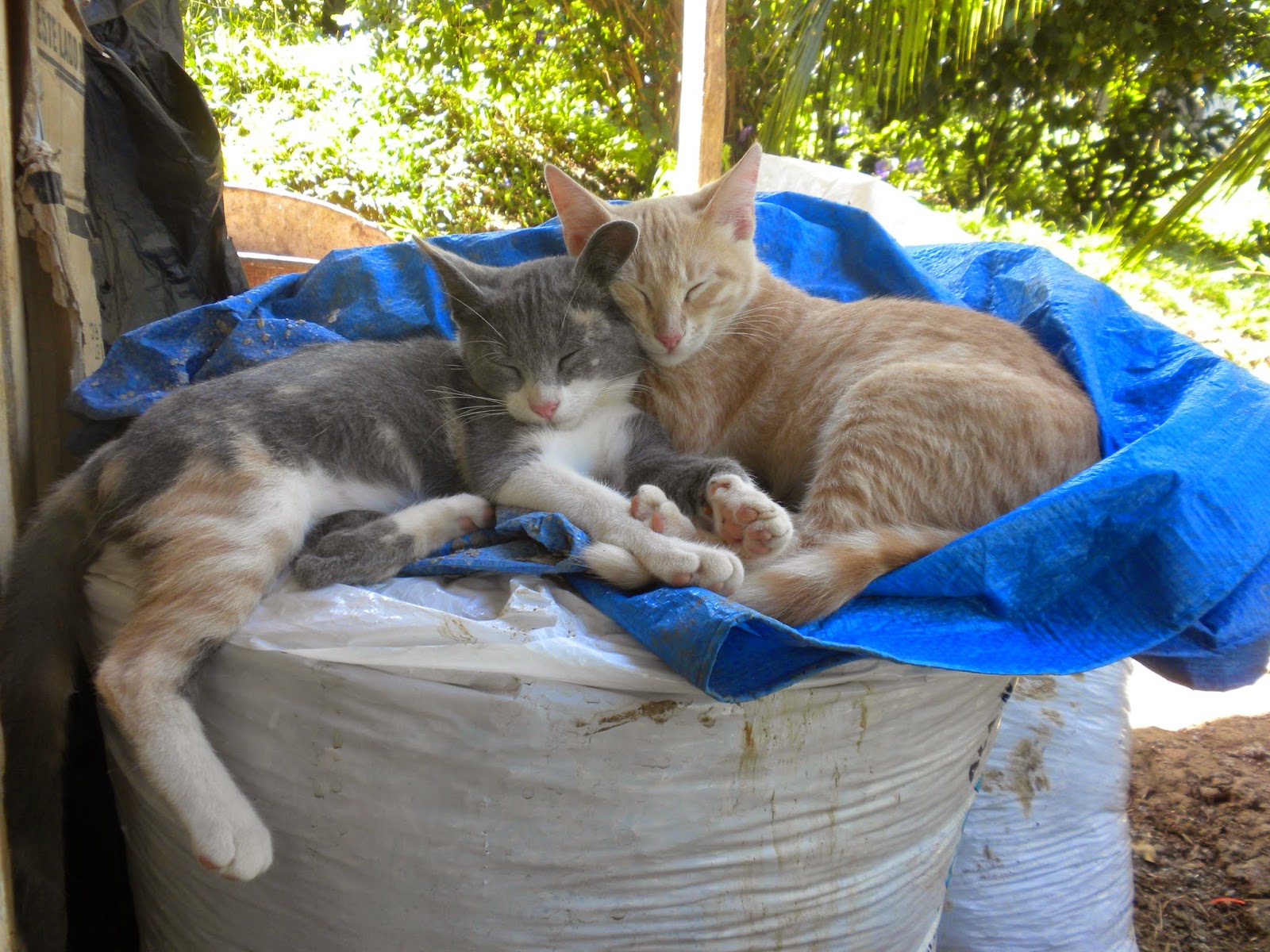
 Kittens!


Pretty soon they'll be catching rats instead of cockroaches...

... If they can escape the children
 
 
...or don't just fall asleep.
 

 Adventure to the mangroves – we didn't get to go fishing, but we found lots of cool stuff! And had lots of fun. It felt like the first few months all over again, with the sense of fun and adventure and newness and unexpectedness…


  Children love my map


 Surveying!


 Still finding big bugs amusing...


Wednesday, March 18, 2015

Panama Cookies

I returned from Training to find school in session, a brand-new Water Committee governing the school aqueduct, and lots of rain.

The former Water Committee president disappeared to the Darién (the exact opposite side of the country) until November, so a new Committee was elected, now with Willy, my “host dad” as president.  This will have some advantages – he is not going to flee to the Darién, he is (usually) responsible and dependable, he has been president before, he is well-educated and knows how to pursue connections,  he is motivated to work – and we still have a reasonable rapport, so there is more hope for working together on improving the aqueduct.

School starting also meant that in the afternoon, after primary school classes were over, the neighbor kids were looking for entertainment – so they came to hang out on my porch.  The entertainment I provided was paper and colored pencils, and a Toy Story puzzle that my brother Josh sent me for Christmas!  (We have a long sibling history with Toy Story – this was supposed to remind me of home.  Turns out it was useful for many things!)


All the rain – and waiting for meetings – meant that I had some time to produce another “mochila!”


Calvin and Hobbes continue to be a source of entertainment.


The members of my Community Projects Committee and I gave our first talk to those interested in building a ferrocement rainwater catchment tank – seven people committed to participating in the project.  We started our talk, which focused on safe water storage, with a game that Nayelis introduced to the group.


And last Friday, I went to a double birthday party in Changuinola (my provincial capital) for a couple Volunteers, and I have spent the last few days in Boquete (a touristy town in the Chiriqui mountains located next to Volcán Barú, the tallest peak in Panamá), at a workshop for revising the Water Committee Seminar Manual, which many Volunteers use to teach their Water Committees how to better take care of their aqueducts.  It's been a great week – learned a lot, had a lot of fun with other Volunteers.

In preparation for all this fun, I decided to make “Ngöbe Cookies” – a favorite of mine, and my fellow volunteers – which are No-Bake cookies (oatmeal-and-peanut-butter-based chocolate cookies that can be made without an oven, perfect for here) made with Ngöbe chocolate (my host family's chocolate balls).  (“Ngöbe” is  more or less pronounced no-bay, so when you say “Ngöbe cookies” it sounds like “No-Bake Cookies” – it's a pun.  Haha.)  I was required to bring a dessert to the birthday party, and I wanted to offer some treats to my fellow workshop participants, so I planned to make these Friday night.

The following short story is illustrative, sometimes, of my efforts here in Panamá:

I committed to making these cookies – I bought all of the other ingredients.  Then I asked Willy, my “host dad,” if he would be making any chocolate balls this week.  He promised me two dozen chocolate balls Friday evening.  Perfect.  I planned to make the cookies, and bring some of the chocolates to sell to other Volunteers (everyone in the rest of the country craves Bocas chocolate), and I even wrote in a letter to a friend that I was sending her chocolate, which I planned to mail this week.

Basically, I counted all of my chickens before they hatched.

Friday evening, Willy came to my house to tell me that he was unable to procure enough cacao, so he couldn't make the chocolates.  Should have figured.  All of those plans that I had made for the chocolates instantly failed.  But I still needed a dessert to bring to the party.

So I opened the jar of Nutella that Mom sent me for my birthday, and put in the equivalent quantity in the cookie recipe.  When I introduced the cookies at the birthday party, they were a huge success.  I called them “Panamá cookies” because “Panamá happened” to them.  Instead of Ngöbe chocolate, they were flavored with a dash of failure and a sprinkle of innovation – which tastes remarkably like hazelnut.  (Thanks, Mom, for saving my butt on that one.)

Prefiero Aqui

“Prefiero Aquí,” or, “I prefer it here,” was my response to Amalia, secretary of my personal Community Projects Committee, when I returned from technical Training in the Comarca Ngöbe-Bugle the first week of March, when she asked what I thought of the place.

The community where we attended training is located in a part of the Comarca (which is a semi-autonomous region inhabited and governed by the Ngöbe people) on the other side of the continental divide.  High up in the mountains – bigger mountains than the ones I live in – the view is spectacular:


But on the other side of the Cordillera (the continental divide) is so much drier this time of year., known as summer, here. In the Bocas del Toro province, everything is still lush and green and muddy, because we still get rain, even if there are a few more dry days than there are the rest of the year. In Las Trancas, the community that hosted our training, things are so dry that there is dust everywhere, and there are constant concerns about having sufficient water.

We had a wonderful time at training – Jess, the volunteer who hosted us, did an impressive job planning all of the work for us to do to both learn and help with her aqueduct construction. But I did think a lot about how the different climates between Las Trancas and Quebrada Pastor affected so much of life. My community has far less trouble getting sufficient water, and can easily grow food all year round, which makes life much easier. Of course, all of the water can have a negative impact, too – easier for water-borne pathogens to spread, and for mold and fungus to grow (on my clothes, between my toes, on my face).

The difference in infrastructure is striking, too – Quebrada Pastor is rather unique for an Environmental Health Volunteer's site, since it is located right on the highway. This gives my community (and me) easy and cheap access to travel – Almirante, the nearest town, is a 20-minute, $1 bus ride away, which enables my community to sell their cacao to the cooperative easily, and buy produce and other things from outside the community. It means that my host family can sell their chocolate balls and lemons and oranges and pifa at a higher price in Bocas del Toro the city located on the Bocas islands, which there is a booming tourism industry. And it means that Willy (my “host dad”) has a Facebook account and does business via email (fairly easy internet access is an advantage for me too!) – something very unusual for Peace Corps communities. To get to Las Trancas, Jess' community, one has to ride in the covered back of a pickup truck for a couple hours on a dirt road constructed mostly by hand – which might be better referred to as a roller coaster than a road.

I realize that my community has some incredible advantages – and after having been here for 6 months, long enough to call Quebrada Pastor my home, I have become very fond of the place. Like all other communities, it has its own challenges – the size and disperse distribution of the population, the divisions among the families, the diversity of the problems and interests of the various neighborhoods, the difficulty in uniting the community, the rampant water-borne diseases – but I have learned to deal with these challenges, to make them my own, and so I can truthfully tell my fellow community members that “Prefiero aquí.”

Photos from training:

Team Pumpkin Pirates show off our work on the aqueduct intake structure...


...And the ferrocement union tank.


Mary Catherine and I pose with our wonderful host dad for the week – father, teacher, store-owner, aqueduct president, and very thoughtful host.


Team Pumpkin Pirates practices doing a water storage talk for some interested community members…


...And Dylan and I demonstrate how to make a “Plubo” (Pluma + Cubo – or Tap + Bucket) – a tap sticking out of a bucket so that you don't ever touch the water with your hands, thereby reducing contamination.