Monday, January 5, 2015

Living Alone

Here the New Year has begun and I haven’t managed to wrap up the old one!  December was a wild month – celebrating Thanksgiving the first week, doing more surveys and measuring flow at spring sources the second week, while moving into my house and preparing for a guest!  Matt, my boyfriend, escaped the Cleveland winter to keep my company for Christmas.

Moving into my rented house and preparing it for company was no easy task.  When you basically live outside – in that nothing is sealed, so that bugs and come and go as they please and there is no such thing as climate control except for a roof to keep out the rain – it is essentially impossible to keep things clean.  Now that I am entirely and solely responsible for all household chores, I have a much greater appreciation for the monumental task that some of these things are.

In my first two days in the house, I had already 1) glued together a poorly-attached joint on a branch of our aqueduct feeding a neighbor’s house that had been leaking onto my property, 2) thermoformed (used hot oil to melt PVC into a desired shape) a replacement pipe to my branch of the aqueduct that had been cut with a machete, 3) scrubbed the inside of the 150-gallon water storage tank that I use when the water goes out, and 4) locked myself out of the house.

In subsequent days, I discovered exactly how long I could store vegetables in a closed container without refrigeration before they start to rot, constantly fought off the mosquitos that seemed to be drawn to my bathroom, mopped all the floors only to have them covered with dirt again instantly, and discovered all the places that cockroaches like to hide (boxes of tea are a favorite, apparently).

And last night I was attacked by the Formics: my house was swarming with ants, in giant clusters on the walls outside, walking in lines into every room, crawling along the ceiling.  They waged a massive, comprehensive, full-scale invasion, and we fought an epic battle that began with spraying DEET around the exterior of the house, then mopping all the floors, and continuing deeper and deeper inside until I was in my bedroom crushing ants that were beginning to crawl into the mosquito net around my bed, threating my very last refuge.  It ended with picking off the remaining survivors one-by-one, hiding behind the pictures newly pinned to my bedroom wall.  I finally declared victory after killing a massive winged queen, hoped I had utterly destroyed them all, and felt like Ender (Orson Scott Card’s Ender’s Game).

These many observation led to a few discoveries – and a greater understanding – about life in the campo.  First of all, I have an even great appreciation for the “cuando hay” mentality that I mentioned before – not only must you eat food when it is available because you don’t know when you’ll be able to buy or find more, but also, if you don’t eat the food immediately, it will very quickly go bad, thanks to the lack of refrigeration.

I also began to appreciate more the gender division of labor that is very strongly maintained throughout the community – I found myself wishing several times that I had a wife to look after the house while I was out doing my work all over the community; it’s a lot to do the laundry, the cleaning, the cooking, and the general maintenance while trying to get work done on top of that!  Plus, when I was gone from sunup to sundown doing surveys, no one was in to house to receive guests, an important form of communication in this place with few functional cell phones and no email.  And I am only taking care of myself – imagine if there were children to care for on top of all that!  I am realizing that, while it is not completely unreasonable to do all of the house chores while working full-time in the US, the lack of modern conveniences makes house chores a full-time job here.  There’s no such thing as microwave-ready meals, or leftovers (which is often what I ate in college).  Laundry can be a morning-long (or even all-day) chore, depending on the availability of water (if you have to walk to the stream to wash it) and how much clothing has to be washed.  And as much as I hating waking up to see a pile of dishes in the sink of my host family’s house, I find the same occurrence in my sink, especially after hosting visitors and offering the requisite drink.

So I have learned a few things from this.  First, I have begun a list of the appliances I miss the most:
1)      Laundry machine
2)      Refrigerator
3)      Dishwasher
Second, the division of labor – that women are expected to perform all of these chores (and more, depending on the location and conditions of the house – like gathering firewood and root vegetables, accompanying children to school, retrieving water, etc.), lacking the technology to reduce the time spent – has continued to inhibit women from seeking other opportunities and roles in society.  Even if the man has a sufficient education to find a job instead of working as a subsistence farmer, the woman is still held responsible for all of the household labor.  So even as the subsistence agriculture lifestyle has change or evolved or shifted, allowing for more leisure time, or more educational opportunities, women’s labor has not changed.

When I held our community meeting to discuss daily schedules, I asked the participants who has more free time and who has to do more work.  The answers were unanimously that men have more free time and women have to do more work.  A few voices spoke up in favor of the men helping their wives with the chores, but the prevailing notion was that women had to do more work because the men had the responsibility of planning for the family.  Naturally, I found this very bothersome – are women not capable of doing the planning?

At the very least, I recognize that, while I can’t solve all of these things – like ease the burden of not having a refrigerator, or completely reinvent gender roles – doing something like helping to provide sufficient and consistent water in the house can go a long way to reducing the workload of household chores.

And this month, I made a preliminary step in providing one option for having water in the house – rainwater catchment!  This little experiment is illustrated below, with more explanation along with the rest of the pictures, most of which are from the time Matt was here visiting, first in Quebrada Pastor, and then traveling throughout the western side of the country:

Panama!  Can you spot the Christmas tree?  Went all the way back to Panama City for the second time this month to go pick up Matt from the airport.


We spent our time in the community doing work:

Meeting with my boss and the community, presenting the results of my 3 months of analysis


Ferrocement Tank Construction Party!  I invited volunteers from around the area to help Matt and me build a rainwater catchment storage tank, as an example to show to my community members – kind a marketing device.  A few curious and interested people even stopped by and helped us out!


Vacation time! I finally lived like a tourist for a few days!

Exploring a cave on Isla Colón; the location is used as a shrine and for holding Catholic mass


 Happy Hanukah!  In Bocas del Toro


Staying and hiking at the Lost and Found Lodge, located in the Cordillera (the spine of mountains that is the continental divide that divides Panamá)


Hiking to a waterfall near Boquete, located in the mountains, with requisite tree-hugging, admiring pretty flowers, and analyzing the aqueduct we found along the way 


Mom sent me Rosie the Reindeer, a family tradition, who kept us company for the entire trip


Venao Cove, located at the southern tip of the Azuero Peninsula in the province Los Santos.  Matt, Rosie, and I pretty much had the beach to ourselves!  We made full use of it – Bananagrams, snorkeling, building a sandcastle…


And returned back to my community in time for New Year’s: Dusk on New Year’s Eve from Ángel’s house


There it is – the Ngӧbe Mansion, as the Bocas Regional Leader calls it.  It is unreasonably large for one person – two guest bedrooms? – but the house where the previous two volunteers lived when they began living on their own, and is plenty accessible to the road and anyone (from the community or elsewhere) who wants to come visit me!


As Mary Catherine, another volunteer in my training group, would say: “A house with a hammock is a house with a smile.”


And some thoughts about my first few months in site:

Chocolate Forest

I live in a chocolate forest
Filled with tiny red frogs
And bright green parrots
And leaf-cutter ants
And gut-wrenching amoebas

I watch the sun rise over the sea
And fall behind the mountains
And rain sweep across the islands
And clatter on the zinc roof

I hear the breeze whisper through the palms
And the screaming brakes of the semi-trucks
And the wailing of a hundred babies
And the squawking roosters hours before the dawn

I smell the sweet stickiness of orange on my fingers
The gentle rotting of cacao pods
The sharp stench of chicken sh*t
The acrid choking smoke of a trash fire

I feel the mud sliding beneath my boots
Fat drops of sweat falling from my eyelashes
Giant ants biting my ankles
The slick mazorca slipping between my fingers

I taste the mamón juicily exploding on my tongue
The picante biting back at my gums
The joints of the chicken feet like human fingers
The sourness of vomited stomach acid

I live in a chocolate forest
And speak in strange tongues
And inspect the holes of latrines
And sing songs about hand washing
And wash my clothes in poopy water

I ride the bus to the internet
And call home from my talking rock
And curse the crying babies
And make bags with plastic thread

I stare at hummingbirds flitting around the hibiscus
And take pictures of giant bugs
And make plans knowing they’ll be cancelled
And tuck my mosquito net tightly around my mattress

I set my drinking water out in the sun
And French braid my hair in the morning
And run along the highway with the trucks
And hide crunchy peanut butter in my room

I think about leaky pipes
And the definition of poverty
And what I’m going to eat next
And whether I can actually change anything

I dream up grand strategies with my counterpart
Then decide all of them are impossible
I laugh and cry and sing and fall hard in the mud
I curse my boots and the rain and the path and the mud
But I stand up again and chant to myself
I live in a chocolate forest


Friday, December 12, 2014

Whatever you do, don't forget your towel

I was packing up the last of my things to move out of my host family’s house and into my own rental house, and at the same time pack up my things for a week spent in Panamá City followed by a day at another volunteer’s site, and remembering the few things still hanging out on the clothesline, I thought to myself, “Whatever you do, don’t forget your towel.”

I couldn’t help but smile to myself – a line straight out of Douglas Adams’ A Hitchhiker’s Guide to the Galaxy.  And fitting: I often feel like a hitchhiker in the galaxy, making it up as I go, not really understanding what is going on all the time, trying to figure all the strange rules and ways of doing things here.  But I do try ever so hard to be prepared for all of it.  Or at least be patient and flexible.

“Any man that can hitch the length and breadth of the Galaxy, rough it, slum it, struggle against terrible odds, win through and still know where his towel is, is clearly a man to be reckoned with.”

I have certainly had my patience and flexibility tested for the last couple months.  November and December are filled with parades and holidays and also are primary months for cacao harvesting, so it is a season of great expense but also great income; mostly it is just very busy, so people are rarely able to keep their commitments to the plans that we make.  This had been very frustrating, especially for one who rather likes to plan, who keeps an agenda book, who tries to be reliable.

Equally frustrating is the complete inability to quantify anything.  I don’t know if this is a fault of communication or of knowledge or of interest.  When I ask for directions somewhere, mostly the response is, “over there.”  If I’m lucky, they will even point in the direction with their hands.  Mostly, they will just point with their lips.  When I ask when something is going to happen, or long it will take, or how long it lasted, responses are usually “in a little bit” or “later” or “a while” or “not very long.”  Rarely is there actually a time or a quantity of minutes associated with any time-related questions.  When I ask how many times something happens, like, “How often do your kids eat candy?” while I’m doing my surveys, or “How many days were you without water this month?” responses are usually “now and then” or “several.”  The best is the circular question about rain:

“How many times were you without water?”
“When it was summer.”
“How long did summer last?”
“While it didn’t rain.”
“How many days did it not rain?”
“Oh, it depends.  Sometimes it doesn’t rain for a day, or three days, sometimes for a week, sometimes for a month.”
“So when does summer happen?”
“When it doesn’t rain.”

This difficulty in quantifying things is especially frustrating for an engineer.

I could go on, but instead I’ll just talk about pictures!

The agricultural brigade in the Almirante parade, for the Day of Independence from Colombia – really enjoyed the machete routine they did.


We had a meeting to discuss strengths, opportunities, weakness, and threats in the community – and we did the “human knot” icebreaker – or at least tried really hard to do it.


Went to measure the flow of a few springs with a few different groups to begin exploring the possibility of building aqueducts. 


Kittens!  The week before I moved out of my host family’s house, the cat decided to have her kittens… on my mattress, the one night that I was in Changuinola for amoebas.  I guess that means that I will get to claim one? 


“Ngӧbe cookies” – these are “no-bake cookies” – perfect for the campo, because you don’t need an oven!  Made with my host family’s home-grown, home-ground, and home-made chocolate, I’ve decided that “no-bake cookies” sounds enough like “Ngӧbe cookies” to make for a good pun.  These were my contribution to our Thanksgiving dinner that we held in Panamá City, and they were a huge hit.


Trying to make naguas look fashionable


Learning to braid the strap of a bag


Cool tree, leaves smell like cinnamon


Cool plants!


More pretty views!


Friday, November 21, 2014

Living Poor

Found some more amoebas; how fitting that my first three months in site be bookended by these unwelcome guests.  At least I’ve learned – from the first time – the symptoms and how to manage them: go immediately to the lab to poop in a cup and begin taking anti-parasite medication.  As a result, I have a little extra downtown with access to electricity and internet to share another post.

Got a couple new limericks, each with their own special story:

Splash of mud, flower still in her hair
Fitting end to the day for poor Claire.
But she smiled once more
At the metaphor:
“Sunshine with a sh** stain” is her flair.


This one really is Claire’s story – a fellow volunteer from my training group, she is in the Sustainable Agriculture sector, and we were roommates in our host family’s house for Ngӧbere training – but the phrase she coined seems to describe Panamá just perfectly, many days.  There is a lot that is beautiful and wonderful about Panamá, about the people who live here – and while we go into each day hoping that we will be able to enjoy the “sunshine,” inevitably, we always get to see the “sh** stains,” too.  I suppose that is the nature of our work.

You can find many other such metaphors, here: last weekend I attended a birthday party.  It was an hour hike up the hill to a house with a gorgeous view of the Bocas Islands; I spent the night up there, awoke to help gather firewood for cooking the massive pig they killed the day before, and then learned from Ema, my original mochila-making teacher, how to make the strap for my first mochila (bag).  As the day wore on, and it became clear that we would not be eating at noon as had been suggested, I began feeling quite hungry and irritable.  The mochila was finished, and without anything to occupy me, Roger began asking me bazillions of questions: “How do you say “piedra” in English?” (Rock.)  “How do you say “ahorita” in English?”  (In a little bit.  This is a silly question, because it’s really more a cultural thing of time than a language thing.)  And on top of that, a Mama Tada church service is going on in the next room (a Ngӧbe take on Christianity, the service is conducted entirely in Ngӧbere and, from what little I understood, mainly consists of the most fantastic cacophony of chanting human voices that I have ever heard).

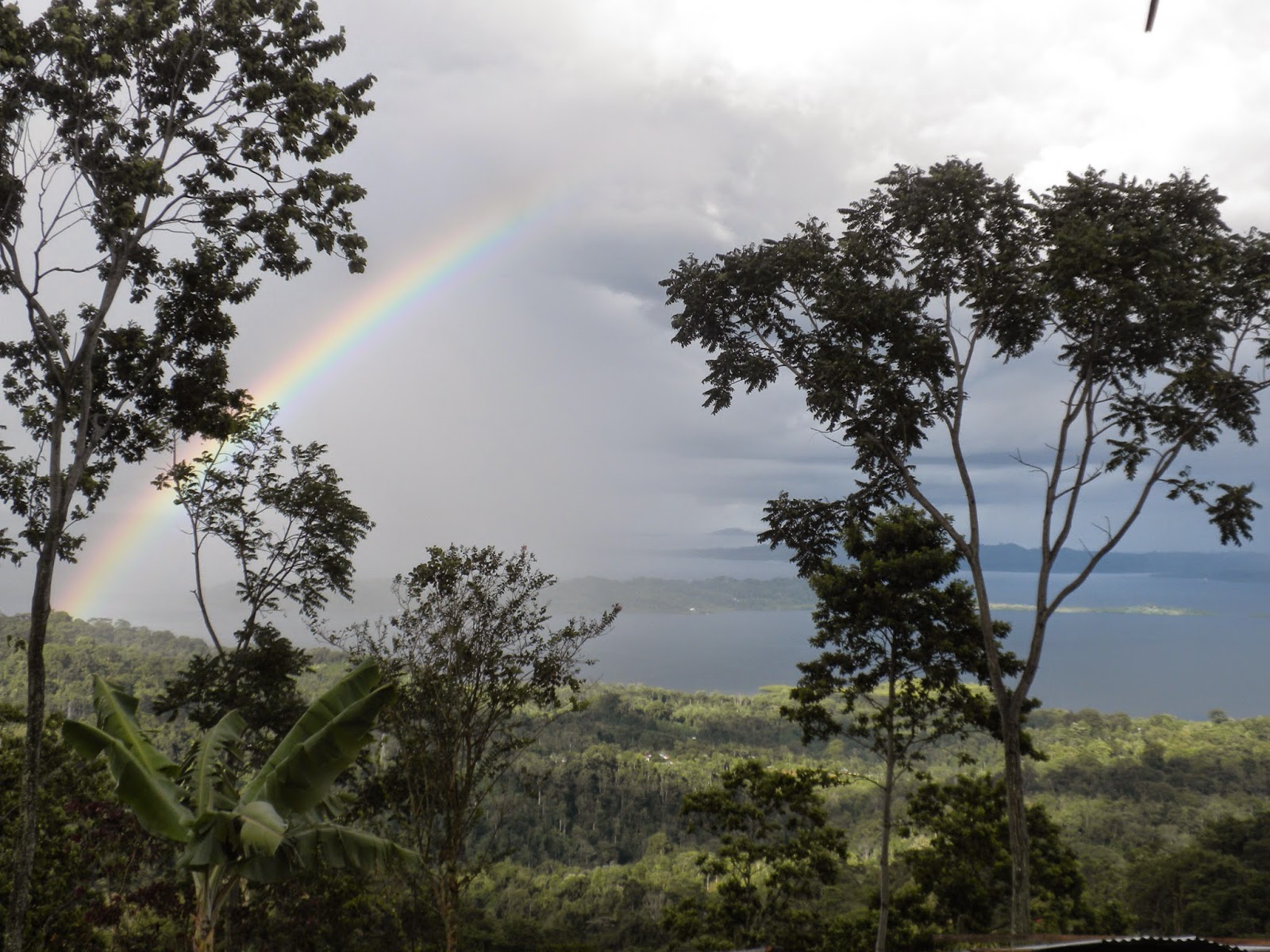
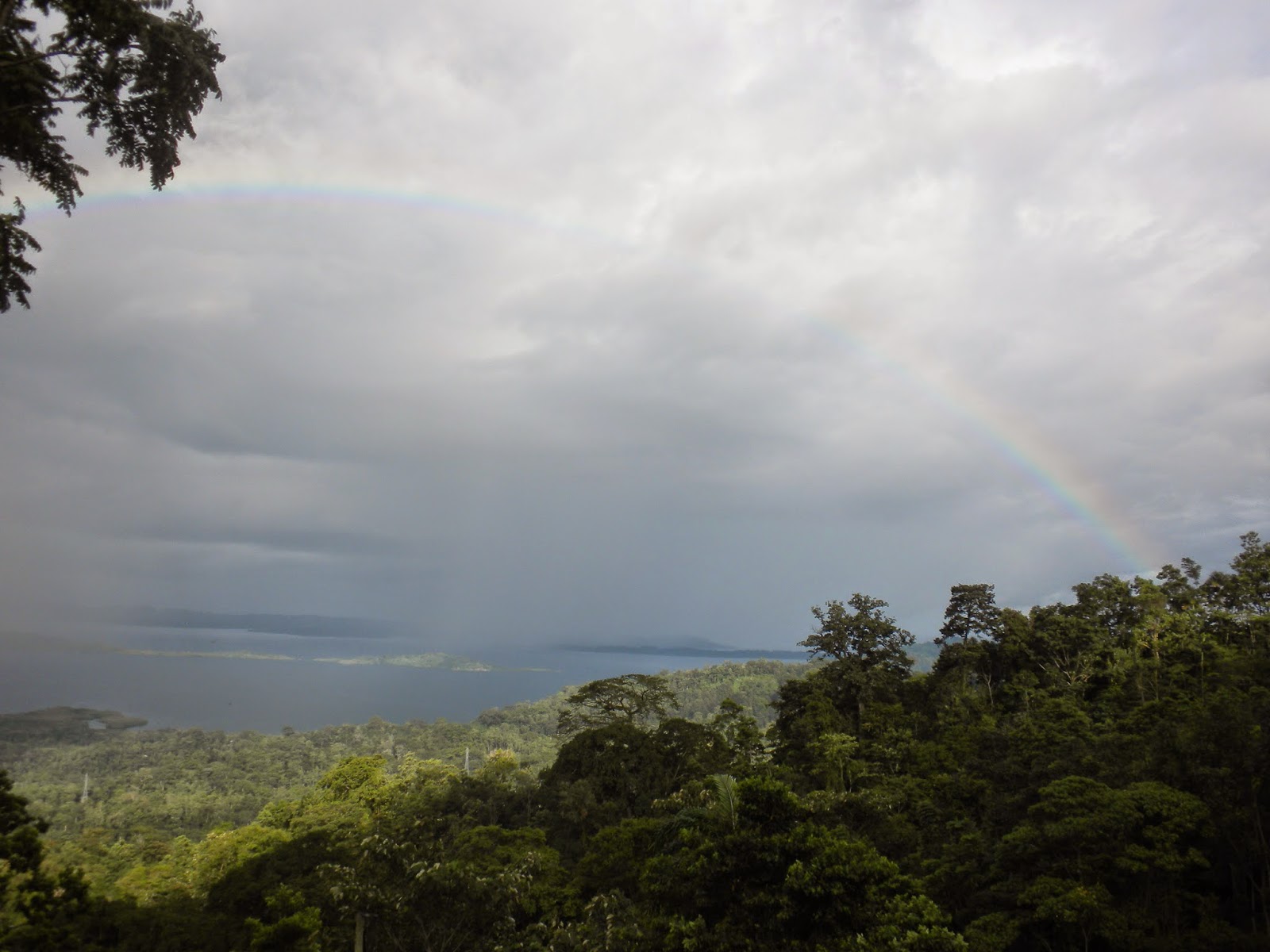
So I’m hungry, and tired of answering English questions, and my ears are hurting from two hours of chanting, and am ready to run out the door and down the hill to escape the whole thing, when, miraculously, the most majestic rainbow appears – a complete arc across the sky, stretching across my entire community, in front of the sea (none of my pictures did it justice).  Surely, it was a sign from God that I was to be saved from this uncomfortable situation.  I ran outside to enjoy it and take pictures.  As rainbow faded, I returned inside, feeling a bit refreshed, ready to take on the unpleasantness once more.  Roger asks me how a rainbow is formed; excited to have a fun science discussion, I ramble about light and color and prisms for a few minutes.  Then he asks: but when did the rainbow begin?  I’m confused.  Do you know the story of the rainbow?

Oh.  You want to talk about Noah’s Ark.  That was really tricky of you.

So he explains to me how the rainbow was really formed, for the first time, as a promise from God to never drown the world again.  And I feel very uncomfortable, having already expressed my views on the matter – that the Bible is not a science textbook.  And so, this rainbow, a perfectly beautiful thing to be enjoyed, has had all of the awkwardness of our cultural clash smeared all over it.


Another example: bananas.  The Bocas province is an especially prolific producer of bananas; the port of Almirante is dominated by the giant Chiquita Banana barges, and the banana plantations stretch for miles around Changuinola.  All to ship those wonderfully delicious yellow fruits all over the world.  Bananas have always been one of my favorite fruits, but once I got into college I ate fewer of them, thinking of how far they had to travel, how energy-intensive it was to get them to me.  Now, I get to eat all the bananas I want, guilt-free!  The only problem is that everyone here eats them in their most unappetizing form: green and boiled.  Bananas – which had the potential to be wonderfully delicious mature fruits – are instead a very bland chalk-like starch when they are green.  And the reason for this habit of eating green bananas turns out to be that the food energy works out better in the immature bananas.  And, when you’re poor and practicing subsistence agriculture, it’s important to get as many calories as you can.  So no more tasty bananas: what a bummer.

That has been my primary realization for the week – it is a real bummer to be poor.

Sure, obviously, intellectually – but also physically, emotionally, I think I have finally made the intellectual connection to the physical and emotional feelings.

The concept of “cuando hay” illustrates an entire mindset, an approach to living.  “Cuando hay” means “When there is.”  It’s the answer to lots of questions: Do your kids eat sweets?  Cuando hay.  How many meals do you eat every day?  Three, cuando hay.  Do you go to the parade every year?  Cuando hay plata (money).  The thing is, you never know when “cuando hay” is going to be.  That is, you never know when you are going to have the money, or the food.  This means that when there are resources available to be consumed, they are consumed.  All of them, immediately.  When people sell their cacao, or earn their paycheck, they spend the money the same day (the 16th and the last day of every month are crazy times to go into town).  If there is food to be eaten, it gets eaten.  There is no such thing as moderation or saving.  This has an unfortunate consequence with respect to alcohol (which so far I have mostly only heard about rather than seen), and the inability to plan ahead (like save up $20 to build a pit latrine).  But for me, it has been most vividly expressed with respect to food.

I never really know when I am going to be eating next.  I’m lucky, here with my host family, in that they do always feed me, and relatively well (which makes me better off than a lot of volunteers), but I still never know what time that is going to happen.  And when I am visiting other parts of the community, then I really am not sure whether I will be given a meal or not.  And when I go all day without having anything to eat, I do get really cranky – “hangry” (hungry + angry).  It’s really hard to do work or to have patience or to be nice when you’re hangry.  So when I am given food, I eat it – even if it’s rice and sardines and I really don’t like it – because I’m not sure when I’m going to eat the next time, and I don’t want to feel hangry in between.

And so I have come to appreciate the strong focus and connection to food – it is an entirely different perspective, a relationship with food that I am not used to having.  I spend more time thinking about food than I ever have.  The people always make the connection between food and work – Willy will say, “This food is a result of the hard work of collecting and carrying all of those lemons yesterday.”  Ángel has said, “If I don’t work, I don’t eat,” (and he enjoyed my quip that “In order to eat, you have to work, but in order to work, you have to eat”).  And this relationship is even stronger if you live in a community of truly subsistence farmers – where everything you eat is something you grew yourself.  My community at least has a source of outside income – cacao – which they use to buy food, so we get to eat a protein source every day and vegetables many times, which might not have otherwise been possible.

I remember back to my first meeting in Quebrada Pastor, when we talked in general about projects and my role as a Peace Corps Volunteer.  We had not discussed any project in particular, yet the first question I fielded after the meeting was from a woman who asked, “So who is going to provide the food for the workers on the project?”  I was baffled; we had not decided on any projects, there was so much other planning that had to happen, I didn’t even know exactly how funding for projects worked… I had no idea how to answer this question.  Finally one of my counterparts saved me: she just wants to know whether the person who is being helped (building the latrine at their house, or their branch of the aqueduct) is going to provide the food for the workers.  And now I understand why this was of primary importance.  Food is always the first thought; it has to be addressed before anything else.

I am not used to this way of thinking about food, nor do I enjoy it.  It is a really bummer part of being poor.  I am looking forward to living in my own house and providing my own food, having control over when and what and how much, having certainty with my steady (if small) Peace Corps allowance.  My ability to escape from this mindset of “cuando hay” is just one more way in which there is a difference, an inequality, an injustice between me and my companions in the community, and a vivid reminder of what I am working for, ultimately.  To be able to escape that mindset, to be able to plan ahead and save and have enough resources that they can be used in moderation as needed instead of as soon as they come into possession: to not have to live like you’re poor.

Early in training, Leigh, a fellow Environmental Health trainee, offered this definition of poverty that she had read: poverty is like living in the ocean in a boat that is just too small; you’re always trying the bail out the water, but the boat just keep filling up, and so you don’t have time to do anything else.  You can’t plan ahead, you can’t make preparations, you have no security, you can’t make any choices about how to spend your time or where you want to go, and any big wave could just completely wreck you.  That’s a hard way to live.  And that’s why we’re here – to try to help escape that trap.

The hard part, of course, is figuring out how, which I am still in the process of doing.  Nonetheless, the Peace Corps office has already asked for us to report on how successfully we have pursued our goals so far.  I submitted my first Volunteer Report Form (VRF) at the beginning of October.  There was not much to say after only a month in site, but we were still asked to submit a “Success Story” from our service.  I opened my Success Story with this limerick:

First VRF and struggling a bit:
A success story with truth and wit?
No diarrhea –
There’s an idea!
That would be some really solid shit.

Pleased with myself, I finally got back the feedback on my VRF recently; most of it was quite positive, but I did receive this gentle admonition with respect to my Success Story, which I have since memorialized into a limerick:

Submitting poop pun limericks is fun,
Just got feedback on my latest one:
“If you wouldn’t mind
Synonyms, could you find?

We do send all these to Washington.”