Wednesday, September 16, 2015

Next Generation

Now that I’ve been around for a year, I guess that makes me an expert.

Or at least that is how I have been made to feel through the last couple months.  First Tech Week gave me the opportunity to teach aspiring Volunteers about work and life in my community.  Then – after serving as translator and guide for Mom and Dad – a senior design class group from Michigan Technological University visited for a week to do some field data collection here.  Then – before they had even left – I ran back to Panamá City to co-facilitate the final week of Pre-Service Training.  And then this last weekend we held the Project Management and Leadership Conference (PML – the same one Ángel attended with me back in May) here in Quebrada Pastor.

Training the new Environmental Health group – during Tech Week, but especially in the training community – gave me an overwhelming sense of nostalgia.  Not that long ago, I was the one with a million questions, full of anxiety and nervous excitement and big ambitions and hidden fears, about to embark on my roller coaster through Quebrada Pastor.  That roller coaster sure hasn’t stopped, but it is a much less jerky ride, as I’ve learned to hold on a little more firmly and anticipate some of the bumps and turns.  And a year’s worth of perspective on this place gives me a great deal more confidence managing my work and life here, accepting the unexpectedness of life that is the norm here.

The visit from the Michigan Tech students took me one step even farther back in my reminiscence; relating to the Peace Corps Trainees required remembering my state of mind of only a year ago, but for the seniors I had to go back to when I was in college, traveling for the first time with Engineers Without Borders, curious and motivated and full of book-smarts, but without a detailed picture of development work.

The 4 students (with a student mentor) that visited Quebrada Pastor are taking an international senior design class in which they partner with a Peace Corps community, visit for a week to gather data, do field surveys, and experience campo life, and then spend the semester using the data to design their final senior design project, which they then offer to the Peace Corps Volunteers, who can use it, if desired, to implement in some form.  I had heard of this program back in March from another Volunteer in my group, and invited the professor to send a group of students to me – thinking, back then, that I didn’t have anything planned for August (soon discovered to be false).  Despite the intensity of plans on both sides of their visit, I was thrilled to be a part of the program.

To me, this is a very cool program.  These students are excited to learn about the world, are excited to help people, and are excited to use their engineering educations to do something useful.  I was (and, a couple degrees later, still am) just like those students.  To get to travel for a week, do some useful work, and get a taste of development while being welcomed into a community to learn about the life and the people there is both a practical and an eye-opening opportunity – perfect for engineering students.

The difficulty is the “doing useful work” part of that.  Without the context of the place, and a thorough needs assessment and understanding of the community, trying to find that “useful work” in a vacuum is very difficult – to the point that the resulting work may not be useful, or worse, damaging.  (I did make a point to share my story from Sustainable Development = Empowerment with the students to illustrate my perspective on development work; they appreciated the lesson in it.)  The cool thing about this program is that, partnering with Peace Corps, all of that assessment and establishing context and forming relationships has already been done by the Volunteer, who can then easily point to and coordinate a project that will benefit the community in which the students can be treated as a useful resource.  This way, the people in the community are still in control of the project, the students can offer their technical expertise, and the Volunteer can serve as the bridge that understands both the perspective of the community and of the students, thereby helping them understand each other even when language and cultural barriers arise.

In our case, the “useful work” was the measurement and evaluation of the school aqueduct.  Willy and I had started doing this, but finding the time to make it happen was a slow process, and I would not be able to analyze the flow and pressure problems without first collecting a full set of data.  The students managed to survey the whole system, measure flow, take water quality samples, and assess demand in the houses and school in just five days.  They will spend the semester analyzing their data, producing a design, and giving us recommendations for the improvement of the system, which I hope to implement next year.

I appreciated this opportunity to be responsible for training the next generation of engineers – whether or not they go into development work, they have a better idea of the kinds of challenges people face in another part of the world.  And I hope that my commentary on sustainable development – as well as seeing it firsthand – sticks with them if they continue with other kinds of short-term work abroad.  It’s tough to do good development walking into an unknown context, so a bridge is important.

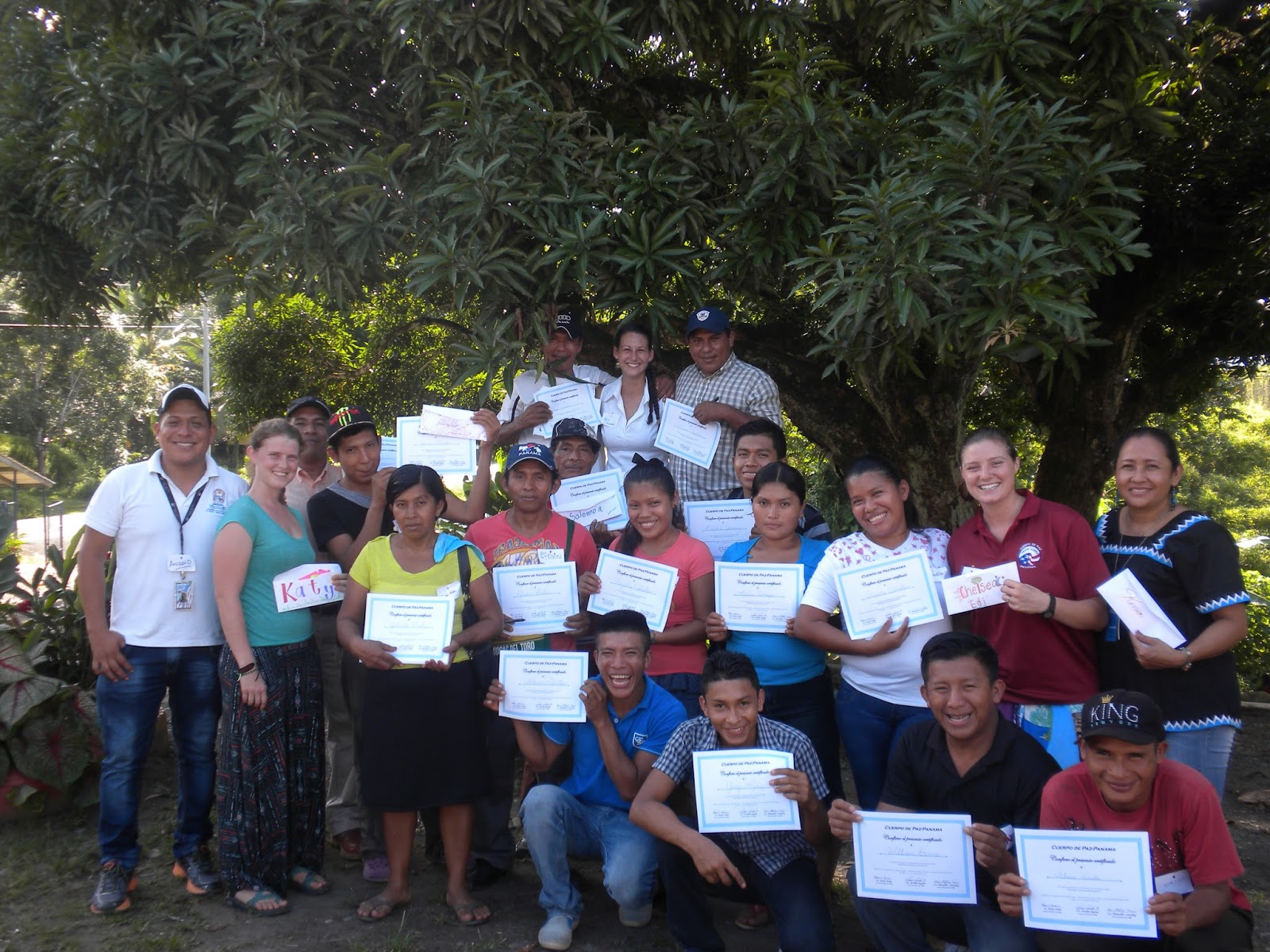
I suppose the final phase of my service will be weaning my community off that bridge, since there will no longer be Peace Corps Volunteers here, at least for a while.  I need to leave them feeling sufficiently empowered and capable to find help and resources and achieve things themselves.  They were already well on their way before I arrived – Lucas had managed to secure several different projects here, and Willy’s rapidly expanding network of contacts and clients for his chocolate business continues to improve his opportunities.  It was Ángel’s idea to bring the PML coordinators to Quebrada Pastor to give more people in the community an opportunity to learn leadership skills, and he and Lucas were responsible for planning the whole thing.  It was quite the success – 15 people attended, and over half of them were under 25.  Looks like Quebrada Pastor is also ready to train its own next generation.

                                                                                                                                                               
Pictures:

Measuring flow with Michigan Tech students


Awarding certificates at the completion of PML-In-Site Conference


Monday, August 24, 2015

Harold and Kumar Visit Alex

To continue with the insanity (because hosting 35 Peace Corps people wasn’t enough):

Mom and Dad showed up on the last day of Tech Week!  They told me, upon arrival, that they decided to call their trip, “Harold and Kumar go to visit Alex” to properly express the road-trip-crazy-adventure nature that their vacation had already begun to take.

What was supposed to be a 9-ish-hour drive was more like 13 hours, thanks to a few confusing signs and a roadblock outside of the Comarca in which a large group of Ngӧbes were protesting the construction of a dam.  And that was just the beginning.

To their credit, Mom and Dad learned to adopt low expectations very quickly – they adapted very well to the best approach to life here – and decided that each day was a good day as long as it included: 1) a solid poop, 2) staying out of the slammer, and 3) a drink.  Based on those criteria, we had a very successful trip!

In addition, they masterfully took to heart the wisdom that, “The only 'plan' Pana-land allows us to make is how we plan to tell the story afterward.”  They learned more in their 10 days in Panama than I did in my first 3 months, it seems!  This post would probably be best written from their perspective, but at least I’ll share what we did while they were here.

Since Mom and Dad arrived as the final celebration of Tech Week was ending, they immediately had the opportunity (while exhausted from their plane flight, 13-hour drive, and handling communication in Spanish without a translator to accompany them) to meet all of the most important people in Quebrada Pastor, as well as my boss and fellow facilitators.  They did so gracefully before returning to my house to get some much-needed rest.

The following day, after finally sending off all of the Tech Week visitors, we took a tour of the tank and latrine projects that were built during the week.  At this point, I realized how perfectly-timed their visit was – after all, 90% of my work is walking around talking to people, which is something difficult to see and appreciate as a visitor, and they managed to arrive right after all of that work had finally produced tangible results!  How fun for me to show it all off!

We also spent some time chatting with Willy’s family and with Ángel.  I mediated the conversations as translator – a role I don’t often play – but we all discovered that some jokes are universal.

On Sunday, despite rain throughout the early morning, I decided it would be okay – if a bit muddy – to take Mom and Dad to Ema’s house.  After all, I wanted to check on the latrines up there, Ema’s family is one of my favorites in all of Quebrada Pastor, and it had an amazing view – all things I wanted to share with them.  I thought I had sufficiently described the journey – “It will probably take us two hours to hike up the hill,” – but that overly-succinct description failed to take into account the heat, the humidity, the slickness of the mud, the steepness of slope of the mountain, all of the climbs and descents that were part of the trek, crossing several streams before climbing up to the highest ridge – an elevation change of over 1000 feet.

Needless to say, it was a demanding hike.  About halfway up the hill, Mom and Dad had some doubts about my sanity in taking them on that adventure, but when they persevered to the top and were greeted by Ema and her family, ready with a big bowl of banana soup, they agreed that their tenacity paid off.  As always, Ema and her family were delightful hosts, and welcomed my parents as family.  Ema taught Mom how to make a mochila, just like my first lesson almost a year ago.

It was very special for me to share Quebrada Pastor – my home, my people, my work, the environment, the culture, the challenges, and the beauty – with my parents after having described it to them for the last year.  It was great for them to understand more completely all the things I had been talking about – now able to connect a face and a person and a place with all of the interactions I describe.  And it was cool for my people to get to meet my family, who they immediately accepted as a part of theirs.  That was perhaps the most wonderful thing about the whole experience, for me – that even though Mom and Dad were visitors, they got to experience campo life from my perspective, as members of the community.


Having survived the most challenging part of the trip, we left Quebrada Pastor to explore the rest of Panamá.  I managed to leave behind my work (knowing that there was still more to be done on the tanks, latrines, and aqueduct), and we all settled into the more vacation-oriented (but no less adventurous) portion of the trip.  This included Cerro Punta (in the Chiriqui cloud forest, the Comarca Kuna Yala (the coast and islands in northeast Panamá), the Panamá Canal and the City, and can all be narrated in the following pictures!

Ema teaching Mom to make a mochila


Ema and me


Alberto showing off the latrine foundation that they built during Tech Week


Mom and Dad hiked a long way to get that view!


In Cerro Punta at the Orchid Farm – called Finca Dracula – hunting for orchids!


Watch out for vampires!  Haha, Dad.


View from our cabin on Isla Aguja (Needle Island) in Comarca Kuna Yala


Panama Canal tour on a boat!


Tech Week: The Musical

The Insanity is over!  And nothing failed!  And actually, I was pleasantly surprised about a lot of things.  And everyone – the people of Quebrada Pastor, the trainees, my boss – were very happy about the results.

I haven’t been able to write for quite some time since it has been one event after another – Tech Week, followed immediately by my parents’ visit, followed by a senior project field trip to Quebrada Pastor, followed by facilitating training in the training community near Panamá City… So finally, as I take a short breath, I can try to describe – in the next few posts – some of what has happened in the last month-ish.

The preparations, as I had indicated, became increasingly hectic as July 19 – the day that the trainees arrived in Quebrada Pastor – approached.  The final week was a blur of meeting with project owners, trying to get the school on board, collecting money for the projects, inviting people to facilitators meetings, and then finally buying materials.

Then people started arriving.  First the 6 Facilitators – fellow Volunteers who had been helping me plan and prepare all along, who were responsible for giving each of the training sessions and leading each of the work groups – all of this in conjunction with the community leaders who were present and knowledgeable to help.  We held several meetings in the day before the Trainees arrived to get everyone on the same page, with some success.  Only thanks to these Facilitators – and my absolute trust in their competence and commitment to follow through on the philosophy of empowerment – was it possible to execute Tech Week the way I had envisioned it.

And finally, on Sunday, July 19, all 24 Trainees showed up, along with a number of Peace Corps office staff.  In all, there were up to 35 Peace Corps people in Quebrada Pastor.

Ángel pulled me aside a day or two into Tech Week to tell me that no one really believed it was going to happen.  35 Peace Corps in Quebrada Pastor?  That just sounds crazy.  Despite having talked about this for the last 3 months, it only became real for most of the community when it actually happened.  (Maybe they will all take me at my word next time?)

And then everything began!

Our accomplishments for the week – in terms of physical construction – included:

·         4 Latrine owners built a concrete latrine foundation (and a 5th finished after the Trainees left, without any help)
o   2 of the latrine foundations are located in a neighborhood that has never had latrines
·         4 Tank owners built a ferrocement rainwater catchment tank
o   2 of the tank owners plan to build additional ferrocement tanks of their own design, now that they know the technique and process
o   2 of the tanks were built at single-parent households
o   Other community members have started expressing interest in
·         6 repairs (replacing damaged pipe, replacing or adding valves to improve function) were made to the aqueduct that serves the school and the center of the community
o   4 more repairs pending
·         Additional survey data was collected for the school aqueduct, to add to what Willy and I had started
·         A pilot incinerator was built and tested
o   Capacity-building among the school maintenance workers for usage and maintenance pending
·         5 Tippy Taps were built among the afternoon student classes

More importantly, there were also several instances in which the leaders of Quebrada Pastor were the teachers, guides, and facilitators, which served my primary goal and philosophy of empowerment – that the members of the community had control over the work, provided their insight, and demonstrated how much they know.  It seemed to be good for the people of Quebrada Pastor, and it was a powerful message to the trainees, who told me how cool it was to get to work so closely with my people. Some of those opportunities included:

·         Each of the owners of the tank and latrine projects was involved in the construction of their project as the primary decision-makers and demonstrating resourcefulness as part of construction techniques.
·         Willy contributed his thoughts to the pit latrine charla.
·         Lucas co-facilitated the composting latrine charla, showing the trainees his composting latrine, how to use it, and how to build it.
·         Willy, Angel, and Bernardo helped groups with surveying, guiding them on the surveying lines and collecting useful data.
·         Rafael, Willy, Bernardo, and Dagoberto helped teach thermoforming and working with PVC pipe.
·         Angel, Alberto, and Enrique helped guide the aqueduct tour, teaching about the process of constructing an aqueduct.
·         Willy, Rafael, and Angel helped with aqueduct repairs, showing the trainees how to do repairs in the field, improvise – often in resourceful ways – and making decisions in the field.
·         Willy and his business partners gave a chocolate tour and guided a waterfall hike as a
·         Lucas helped make the incinerator, so he can potentially help build more in the future.
·         Willy and Lucas took charge of the party on the last day, receiving a food donation from the mayor of Changuinola, decorating the school, and organizing the event.

Even though all of these amazing things were happening during the week, I was so busy running around (sometimes actually literally running) trying to chase down people and materials and keep things kind-of-on-American-time that I was barely able to enjoy it.  Every evening was spent reviewing the day and preparing for the next day, every moment in between there was something to deal with.

However, Panamá did me the favor of – in its usual heavy-handed metaphorical style – reminding me to slow down.  At one point, I was rushing out of the fenced-in tank area while we were working on aqueduct repairs, trying to chase down a group, when I rammed my face – full-force, at top speed – into the barbed wire fence.  A little blood and embarrassment aside (fortunately it was the part of my forehead where I am accustomed to heading soccer balls – and not my eyes), I was fine.  And chose to take that as a lesson to slow down and try to appreciate all of the pleasant surprises along the way (mostly on the part of my community members).  For example:

·         Angel showed up every day to help out all of the construction groups – especially Elsa’s tank (since Elsa was busy making lunch for us every day!).
·         Willy helped with decorations, all of the aqueduct-related work, and showed up to share his perspective in a number of charlas.
·         Lucas agreed at the last minute to give the composting latrine charla when the original plan fell through.
·         Every single host family showed up to claim their Trainee – and I have heard nothing but wonderful reflections on the host family experience.
·         Efraim showed up every day to follow Jonathan, the Trainee staying at his house, wanting to help with whatever Jonathan was working on.
·         A number of community members and leaders who had not indicated that they would help facilitated actually showed up to help – especially for the pipe repair charla and the aqueduct tour.
·         Even though they had me convinced (all the way to the last day!) that it wasn’t going to work out, the owners of the projects did manage to pay the money in full for their tanks and latrines.
·         The first night, 10 Trainees were sent up the hill to Ema’s house to help with two latrines – and they were treated like family for the giant sleepover they had up there – a special experience for everyone.
·         A number of people unexpectedly and generously helped with various preparation tasks – moving materials, cutting surveying sticks, building the incinerator – which made everything easier.
·         The cooks did an amazing job despite confusion with food purchasing – and even suggested some meals that were way more delicious than we had originally planned.

And there was plenty more to grateful for – it just took a moment to breathe and look around to realize that everyone was contributing their best effort to achieve all that we did.  It was an ambitious agenda – and the people of Quebrada Pastor, the Facilitators, the Trainees, and the Peace Corps staff all rose to the occasion.


Granted, I realized during this high-stress week that I still have a long way to go in learning patience and flexibility (if only to be happier in the moment of the stress), but I have come a long way, too.  No complaints – we really did achieve some remarkable things!

Pictures:

Hobbes expresses how I was feeling – exhausted and hardly able to think anymore (also not especially helpful)


Proud tank owners


Talking with the Trainees during lunch at Celio’s house – a 1.5-hour hike – prior to touring an aqueduct


Igniting the pilot Incinerator


Charlas in the school


School Tipico dance performance


After the waterfall hike with Heidy Organic Chocolate Tours (Willy’s company)


With Ángel and his brother Ernesto


Thanking everyone who helped (a ridiculously long speech!)


Performance of the WASH Theater group


So, wait.  Why “Tech Week: The Musical”?

In an attempt to keep things fun (a few moments of levity amid the stress, for me, anyway), we themed the entire week as Tech Week: The Musical.  To give an idea of how this played out, the following are the themes for each day, with the songs to which we made up new lyrics (which hint at what we were doing each day):

Monday: Mulan
We'll Make Volunteers Out of You
A Counterpart Worth Fighting For

Tuesday: Wizard of Bocas
Amoebas and Dengue and Lesh, Oh My!
Follow the Surveying Trail / We're Off to Do a Survey

Wednesday: MC Poppins
It's-So-Easy-And-So-Helpful-Thermoforming-Tubos
It's So Fun to Work Today with MC
Let's Go Glue a Pipe!
Just a Spoonful of Cloro Makes the Parasites Dies Down

Thursday: Lion King
Can You Feel the Smoke Tonight
I Just Can't Wait to Be Clean
Ma Ta Medente

Friday: Willy Wonka
Oompa Loompa – School Charlas – It's Going to Be Awkward
Oompa Loompa – We're Going on a Chocolate Tour


I would post the lyrics, but the songs really make more sense in context.  (But I promise the Facilitators enjoyed singing them!  And I’m pretty sure the Trainees were entertained.)

All the Facilitators performing Follow the Surveying Trail


Sunday, July 12, 2015

Calvin and Hobbes


Calvin died.

She was very sick.  And even though I knew – somewhere in my mind – that it was serious, even though I thought to myself the night before, “Calvin, please don’t go off and die somewhere,” I wasn’t prepared.  She had disappeared earlier in the day.  But she did not go off somewhere to die.  She came home.  And she died right outside the porch gate.

That image of her, eyes half-open, stiff as a board, is seared across the insides of my eyelids.  And it hurts.

One might say that Calvin’s cause of death was “complications due to surgery.”  Just over three weeks ago, I took her and Hobbes to the vet in Changuinola to get spayed (their first trip outside the community, their first bus ride, their first time in the city – it was a big day).  My neighbors had been telling me that they had seen my two female kittens “playing” with the male cats in the area, so I decided the responsible thing to do was what many pet owners in the US do and almost no pet owners in rural Panamá do – get them fixed, before they had a dozen new kittens that I would be completely unable to care for.

Hobbes recovered almost immediately from the operation.  Calvin didn’t.  First she ate little, then not at all, losing all her strength and energy.  Took them back to the vet to have their stitches removed, was told that she had an infection.  Left them with my host family (their original owners – after all, these were the kittens that were born on my bed when I was living there) to go to Mid-Service Training in Panamá City, with instructions for treating the infection.  Returned to find her still in bad shape.  Thought if she didn’t improve – with my care – in a few days, we would go back to the vet, on a day when I didn’t already have a meeting planned.

And then she died.

All that day I asked myself over and over what I should have done differently, how she could have gotten better, what I did wrong so that she didn’t survive the recovery from the otherwise-routine surgery.  And after exploring the (multitude) of instances where I could have made a different choice, in the end – maybe there wasn’t anything else I could do.  I did what I thought was right.  It all turned out fine for Hobbes.  I don’t know why Calvin didn’t get better.  It hurts all the same.

It hurts because I miss her.  I miss the dynamic between her and Hobbes, always playing together, always fulfilling the somewhat opposite – yet similarly mischievous – personalities of their namesakes.  It hurts that she was my responsibility and I failed to protect her from all the risks of the world.  And there are a lot of risks in this world, in this little corner of the earth where bug bites turn into flesh-eating bacteria infections (leshmaniasis), where worms can enter your body from your bare feet in the mud (ascaris), where gut-wrenching parasites lurk in all the untreated water (amoebas)… (Just re-read the 10 plagues limerick from A Peace Corps - Panama Passover for the many delights found in the province of Bocas del Toro.)  It’s a dangerous place, especially for the young, the sick, the old, the injured.

I have though many times since my arrival here that this place is ill-suited for babies (especially while I was vomited out of a hammock, feeling like a sick baby, surrounded by the crying of sick babies).  There are so many risks, and life is so fragile.  I just didn’t want to experience that firsthand, personally.

Of course, pets are seen differently in rural Panamá than they are in the US.  They serve a purpose – to catch mice, to protect the house – rather than companionship.  This is obvious from all the mangy dogs wandering around the community, ribs showing, so skinny that they can fit between my gate posts to steal my food.  And if there often isn’t enough food to feed the children, why waste any resources giving more than chicken-neck-bone-scraps to the dog?

Fortunately for me, Ángel understands this – having seen the way each of the previous Volunteers handled their pets.  So that day I retreated to the sanctuary that is Ángel’s house, seeking support from his family, using the ample cell service to seek support from fellow Volunteers and friends and family back home, finding solace in the isolation and beauty of that lovely house on a hill overlooking the sea.

I remember back when I first arrived, Ángel had said that they think of death differently, as a freedom from suffering (CampoWisdom).  I still don’t think I can wholly buy into that mentality – I too much profoundly value our gift of life – but maybe there is something to that.  Calvin was suffering.  Now she is free.

But I still miss her. 

I guess I’ll just have to love Hobbes twice as much, now.


Patriotism

I had wanted to post this for Independence Day.  Instead, I celebrated America’s birthday in one of the most American ways Panamá would permit me – I ate something at an American fast food chain three times while traveling halfway across the country.  And had pizza and coke floats for dinner (sadly, Panamá doesn’t believe in root beer).

I had known, going into this, that there was something patriotic about joining Peace Corps – that I was serving my country’s interests abroad by promoting international friendship and cultural exchange through the sharing of my education and training.  I knew this – it is, after all, what they tell us – and I believed it too.

Like the rest of my generation, my childhood and worldview was shaped by the World Trade Center attacks that occurred when I was 11, and the ensuing wars and the damage to our international relationships suffered as a result – the misplaced fear and hate and misunderstanding, directed at people who were not the terrorists, that was propagated through the United States, and the mistrust and fear of the United States among people around the world.  And I felt it was my responsibility, as citizen of the United States, to repair that damage, to represent the America that is tolerant of all kinds of people, that shares its material and intellectual wealth with the world for the sake of humanity, that always seeks new and better ways of doing things, that strives for the wellbeing of all people, that uses its power and influence in the world as a force for good.  I wanted to play my small part in representing that America, and I wanted to do my small part in improving my understanding of other people.

But I did not expect just how much Panamá would make me appreciate the United States.  Sure, our educational system needs a lot of work, but at least kids are guaranteed the opportunity to attend all the way through 12th grade and the teachers show up all 5 days of the week, all 6 hours of the school day, no matter how underfunded and understaffed the school system.  Many rural schools in Panamá are lucky if kids get 2 hours of instruction 4 days a week.  Kids may walk 2 hours to get to school, only to find that, inexplicably, their teacher did not show up that day.  The government tries to incentivize staying in school by providing a scholarship – funds to be used for buying school supplies and uniforms – to kids who earn a “C” average (3 on a 5-point scale).  Unfortunately, this has the effect of incentivizing the parents – the ones most concerned about earning the scholarship – to do whatever it takes for the students to get the grades, often including doing the students’ homework for them.  I appreciate what the government is trying to do, but not the actual consequences.

My education is not the only thing I appreciate.  At least when the US government spends hundreds of thousands of dollars on a water project, someone gets fired if it doesn’t work, and something is done to fix it – there is a high degree of accountability.  Many communities in which Peace Corps Volunteers are living have failed government-built aqueducts – some of which never worked at all.

Even if there may be much left to be desired, there are environmental regulations that are enforced.  Towns aren’t full of trash, waste is disposed of in a generally responsible fashion – and these are only the most visible problems that I see.

There may be a lot of complaining, a lot of room for improvement, but in a lot of ways, we can trust our institutions in the United States.  We can trust that our infrastructure was built to a stringent code, that someone is responsible for maintaining it, that someone will be held accountable if it fails.

I find that I do not much trust the institutions here, in rural Panamá.  And neither do my people.  I can see why.  In October, a government agency arrived, unbidden, to build an improved cookstove for the school.  (I had actually spoken with the agency prior to their arrival, and the discussion was about building composting latrines.)  They almost finished.  But they failed to put the metal burners on which to rest the pots on top of the stove and failed to give a training about how to use it, and after attempts to follow-up, they just disappeared.  Now we have a slowly crumbling unfinished stove at the school that is being dismantled piece-by-piece as the bricks are removed for other purposes.  Why trust an agency that wastes its money and doesn’t finish its work – especially when no one understands why they were doing the work in the first place?  Again, the opposite of the Sustainable Development.

And so I find myself telling my people that if they want something, they have to figure out a way to do it themselves.  They can’t wait for generous foreign organizations that seem to randomly give ill-suited gifts (Sustainable Development = Empowerment).  And they can’t wait for the government, which apparently does the same thing.  If they want control in their lives, they need to figure it out for themselves.

And then I pause for a second and realize that I am preaching Libertarianism to my people.  I would not have considered myself a Libertarian.  I like that the government does things like provide education, make environmental regulations, control fair business practices, build and maintain infrastructure, offer health care to everybody, provide a safety net.  But I also have some trust in those institutions in the US.  And it’s pretty darn impressive that our government can do those things.

Granted, there are some significant differences.  Panamá is a lot younger, its institutions have had less time to develop.  And it has been at the mercy of more powerful nations throughout its existence.  And it has less gross domestic product to play around with.  And less already-developed infrastructure, necessary for logistically providing a lot of things.  Where in the US does a teacher have to hike an hour up a hill through the rain and mud to be able to teach 16 students every day (like she does in the community next to mine)?

It is a weird sort of patriotism.  I am continually impressed and amazed at what we have achieved – what is available to us – in the United States.  And I increasingly appreciate how lucky I am to be from America.

However, Panamá is, in a way, now my country, too.  I do, via the US government, work for/with the Panamanian government, on behalf of its people.  I am – slowly – figuring out how things work here.  And if you ever tried to say mean things about Panamá, I would as surely defend its honor just as I would my little brother.  It is a special place all its own.  Even if I still proudly hang my American flag (albeit, inside my house).

Thursday, June 25, 2015

Insanity

There is something insane about planning “Tech Week.”

With less than a month to go, this thought struck me as I was walking to Elsa and Humberto’s house at 6 pm for my sixth-and-not-even-final meeting of the day, preparing for Day Zero.

The thing is, there are a lot of things going on here.  It was always going to be that way, because the needs here are so diverse, because there are a lot of different, motivated people and leaders, because I like doing lots of different things so as to keep busy and not get bored.  I realized back in August during my Site Visit that there were ample opportunities to do a wide variety of environmental health work.  I expressed my plans to try to do all of these things in December and January as I was preparing my Work Plan, and then I set all these wheels in motion in February, with the thought that I would make available every possible avenue of my capacity to help, offering that help to whomever would take it.

I knew that it was not all going to work out, that some attempts were going to fail, but I hoped that a few would succeed, too – as Mom would say, I was taking the “shotgun approach.”  I hoped that when one project was stalling, we could make progress on another, and that I would never really be waiting for things to happen because I would be spending that time working toward something completely different.  Quebrada Pastor made this possible because there are so many different leaders here, interested in a variety of projects.

So I set about different projects.  In November, I encouraged groups that wanted an aqueduct to invite me to measure the flow at the source.  I organized a ferrocement-rainwater-catchment-tank-building party in December to show everyone an example of this novel water collection and storage option.  In February, I walked to (almost) every single house to tell everyone I was offering to orchestrate the construction of storage tanks and pit latrines for anyone interested.  When the aqueduct groups finally formed their Water Committees, I went with each of them to do surveying.  I have been meeting with the school/central aqueduct Water Committee since I arrived, proposing repairs, and finally starting to survey that system, too.

Lots of balls have been rolling for a while now, albeit we had to overcome significant inertia to get them going….

And then in April I found out we would be hosting Tech Week.  Suddenly, all of those carefully and slowly cultivated projects, developing organically each at their own pace, were going to culminate at a specific point, on a rigid, unchangeable timeline, all at once.

That is the insanity of it.  Originally, we had lots of separate things going on, each with their own participants and goals and timelines.  Each had some probability of success and some of failure.  Now these things are all tied together, and the objectives have grown – now we are also teaching Trainees, reinforcing further the idea of capacity and empowerment.  We’re riding that opportunity and excitement – 30 Peace Corps people in Quebrada Pastor!  Wow! – to offer things I  wasn’t even ready to try yet, for lack of time and energy, like Tippy Taps and Incinerators, and I’m trying to take advantage of the context to show my people here – by placing them in the role of teacher – just how much they know.  I’m trying to “aprovechar” (which means something akin to taking advantage of an opportunity) all of the interest that this week is going to generate, and all the extra minds and hands that are going to be here.  It could turn out to be something really cool.

Could.  That’s really the insanity of it.  Before, if things failed, they would fail separately, at separate times, within a small group of people.  Now, everything can fail together all at once in the most public way possible – in front of the whole community, my boss, my fellow Volunteers, and all the new Trainees (not to mention my parents, who are coming at the end of the week, and the mayor of Changuinola, who might be showing up on the last night).  In setting my ambitions high, I am inviting an ever-more-severe fall.

And that fall feels particularly perilous because there is one person who cares an order of magnitude more about the outcome of this thing than anyone else.  That would be me.

I care about the outcome of each of the individual projects that I invested in, cultivated, developed, and cared for.  The owners and beneficiaries of these projects care too, but for their individual projects, not collectively.  And I care about the success of Tech Week as a fun learning experience for the Trainees.  The Trainees, Facilitators, and Trainers each care too, in their own way.  However, my definition of success is tied up in how the whole thing reflects on my community and me.  I’m inviting them all into my home to scrutinize my life and my work – a great opportunity to show off everything here that is awesome, but also a great opportunity to fail.  My hopes and interests for this week are the exact overlap of all the goals of my community members, the training staff, and the participants.

Such are my preoccupations as the preparations begin to exponentially increase in intensity.  I’m still putting forth maximum effort and ambition – I have to plan for both the best-case and worst-case scenarios – but I am trying to temper my expectations so I am not devastated when things don’t work out perfectly (as, of course, they never do).  And that’s the challenge, having so much hope and investment and effort tied up in something, while trying to be realistic.

And, heck, if some things do fail, that’s life.  That’s the nature of this work.  And everyone who is going to be a part of the week – my bosses, the Volunteers, the Trainees, my community, my parents – should know that, or at least be given the opportunity to learn as much.

Here we go!!

In the midst of the increasing insanity, I made note of a few heartwarming sentiments straight out of this very place, reminding me how much I appreciate my counterparts here:

·         Angel: I would rather not belong to any church rather than always be fighting with people within my own church and with people in other churches all the time.  (Church – and organizations in general – is great, except when it primarily serves as a divisive force rather than a uniting force – and I’m glad someone else agrees.)
·         Otilia and her son: We will build this latrine ourselves.  We do not want any help from outsiders.  We’ll let the Trainees help so that they learn something.  (At last!  This is exactly the empowerment sentiment I’m seeking!)
·         Neli and Alberto (married couple): We are both the owners of this tank, so we both have to sign the work agreement.  (It’s good to see such equality.)
·         Principal Carolina: Well, if you’re going to get incinerators for the school to use, let’s get together a meeting as soon as possible and invite all the leaders of the community so that we can organize a waste management committee and clean up this community.  Here, tell me who should be invited and I’ll write up the invitations and you and Omar can sign them.  (I love when other people take initiative to make things happen.)

Pictures:


James, an Agricultural Volunteer from a community down the road, came for a visit to give a training about cacao tree grafts, which was much enjoyed.


Surveying for the Jimenez aqueduct (José is the husband of Ema, my mochila teacher) – how am I ever going to design and construct (and get funded) three separate aqueducts…?


The brownie cake that I made for Heidy’s birthday was so popular that it was requested for Mechi’s birthday this week (my “host mom”) – and enjoyed by all.


Random visit to an artisan shop tucked away in the Ngӧbe neighborhood of Almirante… you never know what you might find if you wander off the main road…


Friday, June 19, 2015

One Year

A year ago yesterday (June 18) marks one year since I arrived in Panamá.  In some ways, the United States seems like a place far away in time and space – a different world, really – and in some ways, it seems that I cannot have possibly been in Panamá for a whole year.  I find that I have adapted to Panamá in a lot of ways – and in other ways I still feel very stubbornly American.  Thus begins a season of reflection, as I go to attend Mid-Service Training in a week, as I meet the new Trainees who will be attending Tech Week in my site a month from today, and as my Training Group celebrates one-year-in-our-communities in September…

I’m going to have to save writing most of those reflections for later – much too busy at the moment – but suffice for now to say how grateful I am for all of the support I have received from friends and family back home (not to mention my new friends, both fellow Peace Corps Volunteers and those in Quebrada Pastor) – throughout this past year.  That support has made all the difference in making this all possible.  Thank you!

A few pictures:

Some activities haven’t changed much in the last year – the similarity of these pictures to those taken last September are proof: I still hang out with my host family, I am still little-by-little trying to encourage the community to make necessary improvements to the central aqueduct, and I still like taking pictures of frogs!

3rd birthday party for Heidy, my “host sister” – I made her a coconut-caramel-brownie using her family’s cacao and coconut oil from Dylan’s site


Cleaning the tanks for the aqueduct to which my house belongs (and the improvement of which is a significant – and challenging – focus of my work) – this little friend provided an interruption and entertainment!