Thursday, April 7, 2016

Meniscus

The meniscus is a piece of cartilage located in the knee that serves as the cushion – the shock absorber – between the two parts of the leg.  It takes a lot of abuse, and without it, your leg bones would be grinding against each other, at a single point – which is painful.

Of course, until a few years ago, I had no idea what the meniscus is – and now I know it intimately in only the way tearing it (and having it stitched up, torn again, trimmed, completely replaced, and trimmed again) can provide.  A meniscus is a difficult thing to repair once it is broken, and its frayed edges can complain loudly.

As this aqueduct construction project continues, I keep finding myself – aside from being the engineer and the construction manager and the contractor and the budget administrator – as the mediator in various conflicts.  I am the shock absorber.

I am the meniscus.

It’s exhausting, and I’m starting to fray around the edges.

One such conflict is between the owners/users of one new aqueduct and the landowner living on one side of the spring source.  His family currently uses the spring for doing laundry, and his cows rely on the water downstream for drinking.  His home is located uphill of the spring, so there’s no way to include him in the aqueduct other than simply leaving him a tapstand right after the aqueduct’s intake structure.

This, of course, he does not find satisfying.  From his perspective, he has always had exclusive access to this spring source, and everyone else used the water farther downstream.  To share this water with the aqueduct – to divide the spring’s flow so that the largest portion is piped into a system of which he is not part – is to take away from him something he has always had.  From his view, he is being generous in graciously allowing the construction of this aqueduct on the edge of his property and permitting the sharing of his water.  With the reduced flow, how can he be certain that his cows will have enough to drink?  Will his family be able to wash their laundry efficiently with the lower flow?  These are his concerns.

From the perspective of the aqueduct users, the way the water is divided is fair – proportionate to the population.  Their uphill neighbor has a separate spring uphill that he pipes directly into his house – shouldn’t they get to have water in their houses, too?  Why is he making such a fuss about his laundry water?  Is drinking water for his cows more important than drinking water for 15 families?  Why didn’t he express all of these concerns from the beginning, when he signed the landowners’ agreement – finally, that is, after they had begged him to do so for months?

These are the stakeholders in this conflict of water rights, of water use, of water scarcity.  The same conflict that I saw working as an intern on the San Joaquin River Restoration Project in California.  The same conflict plays out, increasingly, all over the western United States, and many other parts of the world.  Her I get to see it up close, on this small-scale microcosm of the world.  And I have a role to play, too.  I am the meniscus.

As the femur and tibia bicker back and forth, I get pounded in between, seeking a technical solution, a management agreement, an understanding between the two sides – for the sake of the success of the project.  The sustainability of the aqueduct depends on avoiding this conflict in the future, or having a reasonable way of handling it – because if the uphill neighbor is unhappy, he has more capability than anyone, due to his proximity, of wreaking havoc on the system.  For the sake of the project, I desperately try to help the sides reach an accord – I offer to build the uphill neighbor a storage tank to meet his laundry demands, and I tell the aqueduct users that doing this extra work is an investment in their own success.

I meet resistance on all sides.  I know that the conflict is deeper than this aqueduct – I’ve lived here long enough, now, to know that even though they are neighbors and cousins, there is a divide – they live on two different hills, belong to two different churches, have two different standards of living.

It’s hard to stay neutral.  It’s hard not to get upset or to take things personally.  I feel bettered and abused – rather like the meniscus is my own knee – as I struggle to meet changing demands with the resources I have (limited funds, limited time, and a single, variable spring source), while hearing everyone’s complaints about the process and the other side and all the little pesters in-between.

But I think we’re getting there.  I know it’s not really up to me to solve the conflict – it’s up to the people who live here, because they’ll be here long after I leave, continuing to resolve conflicts and – I hope – enjoying the use of their aqueduct.  I just want to do what little I can to avoid the worst of the possible issues.  Prevent as much arthritis as possible, I guess, if I am to continue extending the metaphor.

I’m the meniscus in plenty of other conflicts in this project, too, but at this point, I’d rather dwell on the positive – which is of course best celebrated with pictures!  After all, the trials and exhaustion of the last month did at least yield the construction of two ferrocement tanks – see below for more…


Pictures!


All that remains to be done on the Beker family tank is fill it with water (to make sure it works! – anxiously awaiting the work day to do so)


Started gluing pipes running through the cacao forest on the Beker aqueduct


Tank construction began on the Santos aqueduct


 Putting together the form that will provide the shape of the tank


Arcadia, Angel’s oldest daughter, made a surprise visit home for Holy Week and energetically helped with aqueduct work – her son, Neno, watched as she took on every task with gusto.  Arcadia told me once during my first few months that if she had been able to continue her education, she would have liked to be a civil engineer.  This knowledge broke my heart – to think, but for our vastly different circumstances, we could have been colleagues, in a sense – but I’m glad she got a taste of construction work that week.  She had no hesitation, no sense of reluctance in doing the same work all the men were doing, and I enjoyed that her enthusiasm in that regard matched my own.  I hope Neno appreciates someday how cool his mom is.


The construction site


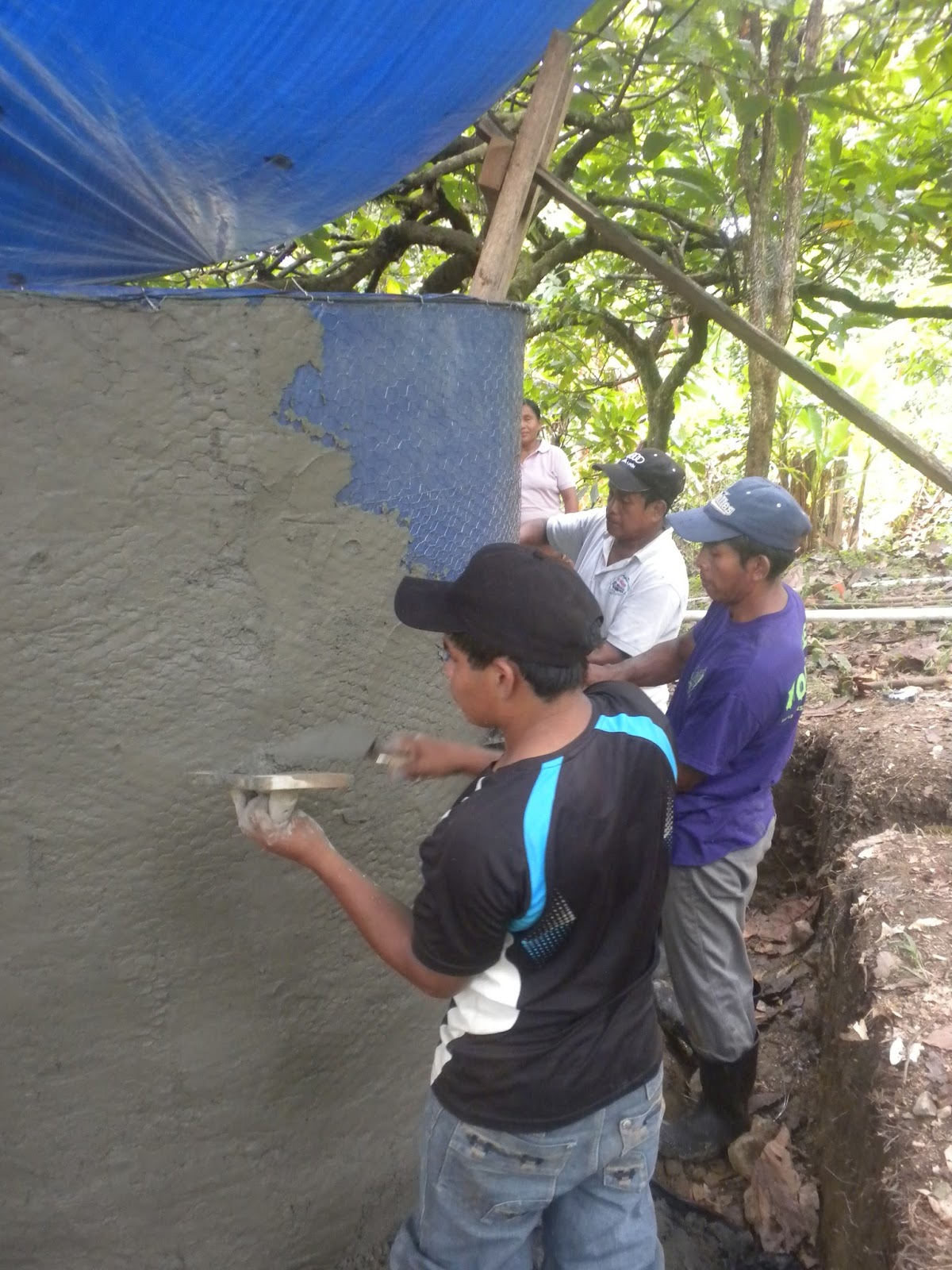
 Father and son working together plastering the inside of the tank


Preparing the tank roof


A little helper taking refuge from the rainy afternoon


Another little helper, taking a break


Nayelis climbing out of the almost-completed tank


Nothing heals a rough day like baby kitties – born at the meeting place of the Santos aqueduct, where momma-cat reluctantly lets me borrow them for a few minutes


Monday, March 14, 2016

Magic

Back in January, as I was waiting for my Water Committees to get organized and ready to buy materials and start our aqueduct projects, I was granted a few precious days that I could sit and read in my hammock for hours on end.  I became totally immersed in a fantasy trilogy called Name of the Wind.  I knew I should have been preparing for the project – reviewing my designs, organizing my materials lists – but every time I started feeling guilty about it, I dove back into the books in procrastination, driving away any feelings with my immersion in the story, in an endless cycle.  Turns out a central concept in the book was a fitting foreshadowing of the looming project.

An excerpt:

“What will happen if I let go of this rock?”
“It will probably fall.”
“Probably?  Hasn’t it always fallen before?”
“Don’t try to boldface your way through this one.  That’s a fallacy.  You taught me that yourself.”
“Fine.  Would it be fair to say you believe it will fall?”
“Fair enough.”
“I want you to believe it will fall up when I let go of it.”
I tried and I tried.  It was the most difficult thing I had ever done.  It took me almost all afternoon.
Finally Ben was able to drop the rock and I retained my firm belief that it wouldn’t fall despite evidence to the contrary.
“I want you to believe the rock will fall and that the rock will not fall when I let go of it.”  He grinned.

I went to bed late that night.  I had a nosebleed and a smile of satisfaction.  I held the two separate beliefs loosely in my mind and let their singing discord lull me into senselessness.

Being able to think about two disparate things at once, aside from being wonderfully efficient, was roughly akin to being able to sing harmony with yourself.

Patrick Rothfuss, The Name of the Wind

I believe I will succeed.  I believe I will fail.  In fact, I know both of these, with certainty.  Just like in this novel, in which all magic in this world of fantasy is based on this ability to hold two opposing beliefs at the same time, the magic of my service also comes from this ability.

My Mom always expressed this sentiment as, “Prepare for the worse, hope for the best” which is just the pragmatic approach necessary to get things done while guarding against the emotional roller coaster that always accompanies things we care about.

Every day that I go into this aqueduct construction project, I am afraid that I am making mistakes.  Is this tank going to hold water?  Will there be sufficient pressure in all the houses?  Did I do my calculations right?  Was my surveying done well enough?  Is there going to be enough water when the flow is low?  Is the Water Committee going to be able to manage the aqueduct and the funds and issues with the users?  Is anyone actually going to chlorinate the water in their houses?  Are there going to be feuds with the neighbors?  Have I anticipated all the potential problems and prepared them for it?

Yet I go on believing that it will somehow all work out, even without having the evidence, for the sake of seeing through the project instead of succumbing to the paralysis of perfectionism.

Knowing that in some ways the project will be a success regardless – the people will indeed have more access to water in their houses, and the experience of organization and working together to achieve this improvement is indeed empowering for these families – while at the same time knowing that in some ways it will also be a failure – they may not see health improvements if they don’t follow my suggestions for proper water treatment and storage and handwashing; someday things will break and I can’t know if they are going to have the money, knowledge, and motivation to fix it; I can’t be sure that they will see this project as empowering instead of yet another example of needing the help of outsiders – this is the magic of maintaining those conflicting beliefs and moving forward with the ambition to do it anyway.

We may not have in our world the Harry Potter magic that makes reading fantasy books so fun – but there is a real magic in this world that is even more powerful – the magic of hope that acknowledges failure, of believing absolutely in both the ambition and its futility, then acting for the best anyway.  I practice magic every day.

Pictures:

Working on the Santos Aqueduct

Finishing up the second intake structure


Taking a moment to play with tadpoles


Working on the Beker Aqueduct

Making formwork for a splitter box (to divide the water fairly)


Ferrocement storage tank construction –


Getting the ladies involved after lunch – making steps for the permanent ladder inside the tank


Setting up the form for the tank


Plastering and reinforcing the tank


Working on the roof


Working from inside the tank


How I feel at the end of each day


Thursday, February 11, 2016

Let Girls Learn

The first week of February I helped facilitate the Sport and Development camp – a soccer camp for girls put on by a fellow Volunteer and funded in part by the Let Girls Learn Initiative.  I brought a 12-year-old from Quebrada Pastor, Milexi, as a camp participant, and Nayelis as a co-facilitator.

The camp focused on women’s empowerment through sport – could I ask for a more appropriate activity in which to participate?!  I’ve been wanting to reflect (for a while now) on what I’ve seen and experienced of gender roles while here – now’s my opportunity.

The camp alternated in sessions of soccer skills and classroom activities of subjects relevant to 10-14-year-old girls – teamwork, women’s education, self-esteem, women’s rights, sexual health, and physical health and nutrition.  After living in Panamá for 20 months, especially in my Ngäbe community, these really are essential themes that it seems still get insufficient attention in the communities where Volunteers live.

But before I get into that; the camp itself.  It was amazing watching the transformation of the girls in three short days, from being so shy they would not even speak aloud their own names to introduce themselves to the group, to working together with enthusiasm and camaraderie in a full-sided soccer match.  It was, on the other hand, also amazing (in a rather more frustrating fashion) how challenging and exhausting it was to do soccer training in this context – where the girls lacked the discipline of organized sports that becomes second nature after a lifetime of being told to be on time and to run from drill to drill (or else suffer the consequences – as it was for all the facilitators and me), and where recognition of success is muted or nonexistent, verbal encouragement does not happen, and fear of looking foolish is so strong that the default response to a question is silently avoiding eye contact and covering one’s mouth with a hand.  Of course, these challenges were what made the transformation all the more spectacular at the end.

In thinking about the importance and potential impact of doing the camp, I want to share a few anecdotes (and I really have so much more than this) that stick out in my memory as illustrative of gender relations here…

Nayelis is 19 years old.  She graduated high school a few months after I arrived in Quebrada Pastor.  She told me, at the time, she was going to take a year off to help at home (as her mom had just had a baby) then go to college.  She also told me she had no interest in having a boyfriend before she finished her education because she didn’t want to make the same mistakes as her older sister, whose first pregnancy derailed her education plans and who is now 25 and married with three kids.

I found out a couple weeks ago, after asking for months, that Nayelis did not get to go to college this year, because there wasn’t enough money.  I was devastated for her.  Of course, then I learn that her two brothers, each of whom had already failed a year of high school, were going to be supported as they repeated a year of school.  So then I was livid.  What kind of priority-setting is that?  The family is using its limited resources to support the boys who failed rather than the girl who has already succeeded and shown her commitment to her education?  The girl who wants to be a teacher and has already gained some experience helping me at every opportunity with giving training sessions?

During the women’s education session at camp, the Let Girls Learn coordinator from the Peace Corps office, Johanna, explained to Nayelis that she could apply for a scholarship to pay all the tuition, room, and board, just like Johanna had done.  Nayelis and I are going to explore that option for next year.

Back in November I helped Katy, a fellow Volunteer, give a Women’s Empowerment Seminar in her community, in which we discussed self-esteem, Environmental Health concepts like water storage and treatment and handwashing, and sexual health and contraception.  The women were fascinated by the last part – sexually transmitted infections, condoms, birth control, etc.  Katy told me later that one woman wanted Katy to come explain these things to her husband.  When Katy arrived at the woman’s house, in her husband’s presence, the woman sent Katy away, declaring that they didn’t need to know these things and didn’t want Katy bothering them anymore.  Katy was heartbroken.

I had, early on during my time in Quebrada Pastor, while doing laundry together in the stream, asked a woman what she had wanted to do when she was a kid.  She had wanted to be a policewoman.  Her father refused to support her education (only giving money to his son for that), so when she met her future husband and he promised to help her go to school, she agreed to get married, at the age of 15.  She had been using birth control injections but stopped because she didn’t’ like the side effects.  A year later she had a baby.  And now, three years later, still hasn’t continued school.  Maybe someday, when her daughter starts school, she says.  (I know another young woman in the community who is doing exactly this, depending on her mother to help raise her kids while she attended school on the weekends, pursuing a degree in teaching.)

To hear her husband tell the story, he had been looking to get married because, living in a house without any women (since his mother left him and his dad when he was young and his grandmother died when he was 12), he was tired of doing the housework by himself and was looking to have someone help him.

All of this highlights the realities of life for many families here.  It is hard to take care of a house by yourself (my standard response to any commentary about my poor housekeeping skills is that I’m looking for a wife, much to the amusement of my community).  That practical reality, plus the limited resources of money and available desirable land, leave little wonder as to why things work out the way they do.  Sometimes a girl’s only way out of her parents’ house is to get married, especially if her education isn’t valued enough to be supported with the family’s limited resources.  Then, lacking access to or control over reliable birth control methods, she had children.  Since her husband can’t nurse the baby, it is automatically her responsibility full-time to care for the baby as well as all the household work, while the man has the freedom to leave, seek other work opportunities, travel, have leisure time, etc.  As she has more kids, the pattern continues.  In this way, the sharp division of labor and rigid gender roles that I see here make some sense.  But also not absolutely necessary.

And some of this is changing.  During my “Daily Schedule” community analysis meeting back in the beginning of my service, when I asked who has more free time and who spends more time working, the answers were unanimously men and women, respectively.  When I asked if this was fair, one man responded – yes, because the man is responsible for planning ahead, for leading the household, for making decisions.  But then Alberto jumped up and countered – no, so I always help my wife with chores like washing dishes so that the workload ends up equal.  Alberto and Neli, his wife, are great – when we built their rainwater catchment tank, I had them sign an owners’ agreement.  They insisted that they both sign, because they are both the owners.

I believe that, little by little, attitudes are changing.  There is evidence of that.  But there’s still a long way to go.  Just the other day, as we discussed rules for work days on the aqueduct project (yes!  We have finally started construction!), I heard men say several times that women do not work as hard, or a woman’s day of work is not equal to a man’s, or that a woman does not make an adequate replacement for a man on a work day.  Even as I watched the women smile as I shook my head and sputtered in protest, no one would speak up alongside me in our defense.

So we’ll have to keep at it.  More girls’ soccer camps, I say.

--

Photos!  

Soccer Camp:

Giving a session about values, goals, and self-esteem, with Nayelis as my co-facilitator


Games for getting to know each other


Dribbling drills


The whole crew!


Other things I've been up to:

Invited Nayelis to celebrate her 19th birthday at my house with her family.  Brownie cake and arroz con pollo were enjoyed by all!


Post-Regional Meeting and pre-birthday "bar crawl" in Changuinola with the Bocas Volunteers!  Yes, Changuinola is a pretty weird place for a bar crawl, and Tuesday night is a pretty weird time for it.  But between the carwash/bar (called Sniper of all things), the tipico dance-off, the muchacho pushups competition, the$5 worth of gambling at the casino, and the bilingual karaoke, it was a fun night.

Helped Chelsea, my nearest Volunteer, with construction of her rainwater catchment tank so she doesn't have to filter and boil her house water anymore.  Took a moment to marvel at how ridiculous (and awesome) pineapple plants are.

Birthday celebration at my house!  Invited Volunteers and community friends.  We had a picnic lunch up at the waterfall, then dinner at my house.  Willy made me a cake... made of nampi (a root vegetable) and eggs!  (Was kinda like mashed potatoes, and delicious!)


Heidy and Hobbes got sleepy before the festivities were over.


Construction has begun!

The Bekers' intake structure:

Excavation


Lunch break (and impromptu English practice)


Efrain is a diligent secretary


Working on the wall of the intake structure


The Santos intake structure:

Finding critters during excavation


Building a clay dam to divert the water


Building the wall