Wednesday, June 29, 2016

Willy + Heidy Organic Chocolates

Like a few other individuals in Quebrada Pastor, I wanted to shine the spotlight on Willy, who has also played a huge role in my life here.

Willy has a fascinating story, and one I know well.  After all, his family was my host family, so I lived with them for my first three months, and I still see them, hang out at their house, and do work with them all the time.  We work together on aqueduct issues (he’s the president of the school aqueduct water committee), he enthusiastically helps me with trainings that I host for Volunteers and for the community, he loves helping me host visitors, and I help promote his business.

For a 24-year-old, he’s incredibly accomplished.  He just officially registered his business, Heidy Organic Chocolates, a year ago, and has regular clients all over the Bocas Islands, expanding into other provinces in Panamá, and occasionally buyers from other countries.  That’s pretty darn impressive for a guy who runs his business in his family’s house, usually just with the help of his wife and another person or two, making chocolates by hand without any electricity whatsoever (unless you count the solar-panel-powered lamp that allows them to make chocolates sometimes until 3:00 am).

He is passionate about his business because he is passionate about his home.  He was raised by his dad and his grandmother, but when she died, Willy was 12, and his dad’s muscular dystrophy caused him to deteriorate rapidly thereafter, so Willy became the sole caregiver for his dad, at the same time he was attending high school and working at a store in Almirante to support the two of them.  He was forced to grow up fast.  He’s an unusually fast learner (he picked up speaking some Mandarin just by working at the Chinese-owned store, and he learned how to survey with an abney level faster than some Peace Corps trainees), and he was almost always the best student in his class, with a never-ending appetite for learning.  Though he was offered special study abroad opportunities as far away as Ecuador and France, he chose to stay in Quebrada Pastor to care for his wheel-chair-bound father – which also excluded attending university to study science and become a professor, as he had wanted.  So he turned his energy and ambition to making a better life in Quebrada Pastor.

He married Mechi and they had a daughter, Heidy.  Then he turned his high-school business degree – with his daughter as inspiration – to the creation of Heidy Organic Chocolates.  Though at first he and Mechi were working his father’s land to grow cacao and other produce to sell in Almirante, his business instinct led him to improve upon this model – Why sell cacao beans to the cooperative if you can process them into a consumer product – bars of baking chocolate – and sell that directly to customers, maximizing your profit?    And why sell cacao bars in Almirante when you can get a better price selling them to tourists on the Bocas Islands?  And isn’t it easier and more reliable to sell to regular clients (the tourist industry), ensuring a consistent demand, than just selling to random tourists on the street?  And what if he could make other cacao products that consumers want, like cocoa powder, cocoa butter, dark chocolate candy bars, and cacao nibs?  So with his charisma and work ethic, he built a network of clients – hotels, restaurants, and stores – and reliably followed through on delivering their orders each week.

Calling the business Heidy Organic Chocolates was no accident – he had been thinking about the future from the beginning – he wanted this to provide Heidy with the opportunities he had wanted as a child.  And he wanted to do so in a sustainable, responsible way.  He is well-versed in the concepts of sustainable agriculture, organic produce, and fair trade, and uses these both to guide his business model and to promote his products to consumers.  His vision is community-oriented; he hopes that one day, the associates of the business – fellow community members – will share in the work of running the business and in the profits, benefitting other families of Quebrada Pastor.  He hopes that, with more help, they’ll be able to produce more cacao products and host cacao tours for visitors.  He hopes that when the business becomes truly profitable, they can invest in the Quebrada Pastor school and other community projects – that it can be a force for community-run development, and an impetus to improve the community – say, through better solid waste management, an example he often cites as a priority.

And to me, community-initiated, community-funded, and community-run development is indeed an appealing thought.

So even though I have no expertise in business or marketing or tourism or agriculture or food products (well, except for my ability to consume chocolate) – I agreed that I would help however I could.  So I connected him to the Peace Corps network – which helped him sell to eager new clients (Volunteers all over Panamá) and opened up opportunities to connect with new clients owning stores and restaurants in other parts of Panamá.  I’ve helped orchestrate trainings by agro-business and cacao Volunteers.  I’ve tried to provide some ideas, or at least be a sounding board for his creativity.  I’ve facilitated communication, sometimes through translation, and encouraged setting up systems to make transactions easier.  And I’ve been his promoter, following up leads from other Volunteers, inviting friends to go on his cacao tour to give him practice, brainstorming and helping pursue ways to raise money to invest in growing his business.

To that end, I’m always looking to connect him to new resources – be that potential clients, sources of grants and funding, more information about business and cacao products, agro-business training opportunities, or people who want to go on a cacao tour – so if you know of something that could be helpful, please let me know.  Or better yet, let him know yourself, at heidyorganicchocolates@hotmail.com or Heidy organic chocolates on Facebook, or even his website when he gets that up and running.

And do let me know if you want me to bring you any cacao when I return to America in September… J  I hope by the time I’ve run out of my supply, he’ll be shipping chocolate directly to me in the States!

--

Pictures:

Willy loves giving cacao tours.  Every time I have visitors, we go on a tour -- and he's been improving the content each time.  Little-by-little, he's been increasing the amount of English he uses in the tour.  He's getting ready for a legitimate ecotourism aspect to his chocolate business!

From some of the more recent tours:


(He doesn't let tour participants cut open cacao pods with machetes anymore.  Probably wise.  We'll call that a win for teaching about America's (litigious and liability-oriented) culture.)


Willy's tour was part of Tech Week last year!


Willy also loves the opportunity to share food with visitors, which he likes to include in the tour.


--

The Business:

From the official founding of the company, with its associates


Some of the lovely lady associates of the business, including his wife, and my good friend Nayelis (who has been working for Willy to save up for college next year).


Preparing the scene for the cacao photo shoot -- Willy had a WWOOF Volunteer for a few months, who has been helping him set up a website and continue developing his ecotourism component.

--

Willy has been involved in every seminar we've done in Quebrada Pastor -- here's a few:

Willy helped organize the Project Management and Leadership Seminar for several leaders in the community - and still cites things from the Seminar that have helped him be a more organized and better leader


And he hosted a cacao grafting training - given by an Agriculture Volunteer.


Willy was the only person from the all aqueduct groups in the community I worked with who wanted to learn how to use the abney level for surveying -- and then mastered it quickly -- to help gather information about the school aqueduct for making repairs

--

Celebrations!  Willy is always pleased for me to make a birthday brownie cake (using his chocolate, of course), or to take part in whatever silly American traditions I come up with...

Heidy's 3rd birthday


Willy's 24th birthday


New Years 2016


Mechi's 20th birthday
 

On a family outing, harvesting oranges and lemons and cacao, during my first month


Celebrating Rosh Hashana 2014 with Willy's dad, Bernardo


Everyone enjoyed the apples and honey -- and the Hebrew prayers.


Willy really got into taking the pictures for the scavenger hunt from Passover 2015


It's been a lot of fun working and playing together!

Monday, June 13, 2016

Family (Passover Potluck 2016)

Last year, the Peace Corps Panama Passover Potluck enjoyed so much success that new Volunteers were asking me months in advance whether there would be a Passover 2016 – based only on seeing my blog post.

So of course, I had to do it again.  And step it up.

First, I decided that instead of hosting Seder at my house and inviting Volunteers and my favorite community families, I would ask to hold Passover at the house of one of my favorite families – at Ema’s house, my abuelita.  Ema and Jose were delighted to host the Seder, but I needed to check about a few things first.  Part of the Seder is to have 4 glasses of wine throughout the course of the ceremony, each playing a different symbolic role.  Ema’s family is the Ngäbe religion Mama Tada, which prohibits, among other things, alcohol and dancing.  So I asked Ema: I understand that your religion prohibits alcohol, but can we include wine as part of this Jewish tradition?  Her response: Wine doesn’t count!  Of course!  This Seder was off to a good start.

Three other Volunteers arrived April 30 to join the Seder.  We carried several boxes of wine, matzah, Mom’s-recipe charoset, Seder plate items, and kosher-for-Passover appetizers on the hour hike up the hill, picking up Angel’s family along the way.  Once everyone was present – twenty-some people – and the sun was setting, the Seder began.

This is the first Seder that I’ve been to that was conducted in four languages – some Hebrew, some Spanish, some Ngäbere, some English.  Ema’s family was fascinated by the Hebrew prayers that we sang – lighting the candles, blessing the wine, the parsley, the matzah – and translated into Spanish.  We made sure everyone participated in the ritual handwashing at the beginning, as good Environmental Health Volunteers – after all, God wants your hands clean before you eat so you don’t get sick.

Rather than read through the Haggadah, the other Volunteers, Nayelis, and I acted it out in a sociodrama, true Peace-Corps-capacitation-style.  Zoe was Pharaoh, David was Moses, Nayelis and I were Egyptians, MC was God, and Ema’s family was the Hebrews.  Nayelis and I yelled at Ema’s family as if they were slaves.  MC and David communicated via cell phone – and it turned out that God kept running out of money on her phone, cutting short her calls to Moses.  Nayelis and I ran around as if the plagues were chasing after us.  It helped that the family had been listening to Moises on the radio, and knew the story – though this was a slightly different interpretation.  “Should Moses really be talking back to God like that?” someone asked me in response to the David’s increasingly sassy phone calls with MC.  “I mean, that’s actually kind of accurate – pretty much all of the Jews in the Bible argued with God!”

After the Seder and our four glasses of wine, prior to dinner, the kids even started an impromptu dance party – and were joined by the matriarch herself, as 70-something-year-old Ema surprised everyone and came out to dance tipico with MC.

The Seder sociodrama was hilarious, the potluck was delicious, the entire experience warm and joyful – better that I could have possibly imagined.  Ema’s family loved it.  The Volunteers loved it.  I loved it.  It felt just like all of those fun Seders of the past – with family and friends, part ceremony, part ridiculous, irreverent hilarity.

It was as close to being home as I could get without actually being there.  Here, in Panama, with my second family, this Seder had that warmth and comfort and closeness and joy.  Which is really what Passover – with its tradition of remembering and of passing along stories generation to generation – is all about.  Celebrating with family.

Next year in America!

--

And, thinking about the family that is my community, I wrote this:

My Gente

In the beginning, they were my gente.  My people.
My people who were assigned to me.
Whom I was supposed to help.

Then, they were my gente.  My people.
My people with whom I live.
Who share their home with me.

Y’know, my gente.
Who feed me strange things.
And teach me their world.
Who frustrate me.
And make me smile.

Finally, they became my gente.  My people.
My people because I am a part of them.
And they are a part of me.

I am one of them; we are family.
I would fight for them,
They would fight for me.
We may squabble sometimes
But don’t you dare say anything bad about them.
‘Cuz they’re my gente.
Like my little brother
On the bus with me
Getting picked on by the big kids
Back in sixth grade.

They are my gente.  My people.
They are mine.
Because they are me.

My gente.  My people.
I wonder.
Can all the gente of the world
Become my gente?


--

Pictures:


We sing in Hebrew the prayers at the beginning of Seder.


We pour the first glasses of wine for everyone…


…and hand them out.


I’m explaining something – Ema and Jose have front-row seats.


MC explains the importance of the ritual handwashing.


Saturday, May 7, 2016

For Mom

Today is Mother’s Day – in the United States, at least.  In Panamá, they celebrate Mother’s Day on December 8 every year, as a national holiday.  But even if those around me aren’t celebrating their mothers today, I want to celebrate mine.  After all, she’s the biggest reason I’m even here in Panamá right now – which unfortunately means I can’t be home today to help with the yardwork.

Mom told my brother and me once, after we asked why there is Mother’s Day and Father’s Day but no Children’s Day (as in, Why do you get presents an extra day each year and we don’t?), that it’s not about getting presents, it’s about being able to honor someone else.  Everyone has a mother and a father to honor, but not everyone has children.  This way, no one gets left out.

That stuck with me – probably because it made my brain hurt when I was a kid – as a wise and different approach to what holidays mean.  There’s a lot of wisdom that Mom has passed along through her words and her actions throughout my life – and much of that stuck with me and came here to Panamá, helping me through work and life here.

Mom has always encouraged – insisted – that I try to see things from others’ perspectives, starting with the fights my brother and I had, but soon applying to everyone with whom I interacted.  And I always saw her practicing empathy herself, as a role model, seeking to understand why others do things, seeking to take into account and accommodate their point of view when dealing with them, and seeking to forgive them through that understanding.  One could easily argue that she is the reason I was even interested in Peace Corps as an approach to sustainable development in the first place – after all, the entire approach is based on immersing Volunteers in the context of their communities, truly understanding where people are coming from, living like them and with them, and thereby gaining – even adopting – their perspective, before even trying to figure out how we can use our training to help solve the problems they want.  None of this can happen without development that empathy – and that’s what I came here craving, knowing, thanks first to Mom, that solving any problems involving people first requires understanding those people.

I also wouldn’t be here if Mom hadn’t raised me believing that I could be anything I wanted that I should do something I enjoy, and that it should involve helping other people.  She herself has always lived to help other people – as a sister, as a daughter, as a nurse, as a wife, as a mother, as a volunteer in many organizations.  That impulse and example by her encouraged me to gravitate toward service that is fulfilling and necessary work; so I studied environmental engineering, and wanted to try out using it as a Peace Corps Volunteer.

I wouldn’t be here without the courage and confidence Mom instilled in me.  Without a lifetime of reminders that women are equal to men, and that I can be assertive and stand up for myself, I don’t know that I could have withstood the excessive machismo encountered in the cities, or challenged the gender norms in the community.

And indeed without her doctrine of tolerance for people who are different, and her open-mindedness to new things and ideas, I could not have been nearly as well-equipped to immerse myself in a foreign culture – or perhaps had the desire in the first place.  She encouraged my sense of adventure to go new places and try new things – like when she drove alone from Iowa to California after graduating college, leaving everything that was familiar to try somewhere completely different.  Sometimes it is difficult to accept things that are different, especially when they are hard or seem negative.  But she always encouraged me to find the good in people, even if we disagree, a skill I exercise a lot here.

Mom has never stopped working to become a better person throughout her life, and this example too, inspires my journey.  A big part of being a Volunteer is to reexamine one’s life – especially with the new context that prompts so such learning and questioning, plus the slower pace of life that affords extra time for pondering.  I hope that an outcome of all this is to be a more thoughtful and improved human being, as she always strives to be.

I do see her characteristic work style in the work that I do here, too.  So much of what she does it to make others better, to make other people look good.  She says of her doubles tennis playing style that she’ll keep the ball in play (chasing down tough shots, making saves, playing defense, setting up the point), so that her partner can put away the finishing shot.  I have my own sports analogy for this – as a center-midfielder, my expertise is in organizing the field and setting up the offense to score the goals – but either way, the point is the same: like her, I’m best at organizing things to give others the opportunity to shine.

Here, as a Volunteer, that is a great quality to have learned from her – because that’s our job – set up our community leaders to have even greater capacity for leadership, show people they have the power to improve their own health, help water committee members become the proud owners of an aqueduct that they built themselves.  Here, I’m doing my job best if I can leave behind my ego and all the credit for development belongs to the community.

So as I reflect on what I’ve been able to do here and how I even go here in the first place, I just want to say – Thanks, Mom.  I owe it all to you.

With love – Happy Mother’s Day!


Sunday, April 24, 2016

Aqueducts!

This aqueduct project is a marathon.  I mean, I assume the metaphor is accurate.  I’ve never run a marathon.  Guess you’d have to ask my brother, the ultra-marathoner, what that’s actually like (https://steeplesandsunglasses.wordpress.com/).  We’re on the final leg.  It’s almost over.  Construction began in January.  It’s been three exhausting months.  The project itself, of course, began long before that, a year and a half ago, as we formed water committees and started gathering all the data needed to make the designs and apply for the grant.  And I can’t be sure it’s going to work – to see whether my modeling and calculations hold up – until construction is finished.  That time is coming soon.

And even with that, this won’t be the end of the project.  Sure, in the next month, I’ll have to close out the grant, turn in the receipts, write up the report and as-built drawings.  But that’s not really the end.  Really just “the end of the beginning” (thanks, Churchill).  Eric, my previous Volunteer, told me that he thinks about Quebrada Pastor every day, that he spent the last two years wondering and hoping that the aqueduct projects he helped build still work, that people still have water.  When he came to visit last month, he asked each group if they always had water, if anything went wrong, if they were still collecting the monthly fee.  It was a window into my future – hoping that the Water Committees remember their training enough to manage their aqueducts well, hoping I had anticipates and avoided potential problems, wondering whether the project was ultimately a success, if it really did improve people’s health and lives.

That’s a tough thing about this kind of work – change is slow, results are slow to see.  “Sustainability” means we’re looking at the long term – which means it will be many years before we can prove whether any of this is truly sustainable (though perhaps fewer to prove whether it fails).  Every time Angel asks me about the craftsmanship quality of their work, I’ll tell him, “It’s your aqueduct.”  He’ll tell me, as he goes to improve it – “We’re not thinking about the short term.  We’re building this for the long term.”

I’m glad they take that kind of responsibility.  It seems like a good sign for success, that sense of ownership.  Aside from telling them that, “It’s not my project.  It’s your project,” I also remind them that, “I’m not the boss.  The Water Committee is the boss.  I’m just the engineer.”  This sums up our roles in the project – and shows that they are in control.  They are the ones making this happen.  They are going to have water in their houses because of what they did.  And they are going to take care of this thing in which they have invested so much.

They are responsible for the decision making, and a lot of the hands-on field problem-solving.  The most joyful moments of the work for me are when we combine my analytical contribution – this is what is going to make this work the way we want it – with their hands-on resourcefulness – so how are we going to make this happen?  That’s the part that’s really fun, because I feel like we are maximizing our roles in this project, balancing our contributions, each of us playing to our strengths, a true team.  I hope they find it empowering to know that they can do the problem-solving needed to get water to their houses.  So much of learning in the campo happens by doing and seeing – not by reading and writing (much to my chagrin when I want to draw them a diagram) – so working together on this infrastructure project is a vivid way to learn that sense of empowerment, ownership, control, leadership, teamwork, organization, planning, and problem-solving.  And that’s a benefit unto itself, apart from getting water in the house.


We’re almost there.  So close.  I’ll keep y’all posted on whether this thing actually works.  When we start it up, anyway.  After that, it’s all up to them.

Pictures:

Gone fishin’ – an evening excursion with another Volunteer – we didn’t catch anything except for the glimpses of dozens of starfish in the shallows, a few alligators in the mangroves, several satellites streaking across a shining Milky Way, and swirls of bioluminescent creatures in the water.  That’s enough of a catch for me!


Gone fishin’ part two -- a daytime trip in Quebrada Pastor – my guides paddled me in a tiny dugout canoe through the mangroves (without capsizing!) out to the sea, where they showed me starfish, coral, parrot fish, spiny urchins, jellyfish – there’s a whole aquarium right at my doorstep!  Then they brought me back and served me some fish they had caught that they fried up with coconut rice.


More critters!


I've ever seen the red frogs with spots on them!


 Construction continues…


A “photo shoot” for Willy’s business, Heidy Organic Chocolates – be on the lookout for a beautifully-illustrated website, coming soon, so promote his chocolate products…


Thursday, April 7, 2016

Meniscus

The meniscus is a piece of cartilage located in the knee that serves as the cushion – the shock absorber – between the two parts of the leg.  It takes a lot of abuse, and without it, your leg bones would be grinding against each other, at a single point – which is painful.

Of course, until a few years ago, I had no idea what the meniscus is – and now I know it intimately in only the way tearing it (and having it stitched up, torn again, trimmed, completely replaced, and trimmed again) can provide.  A meniscus is a difficult thing to repair once it is broken, and its frayed edges can complain loudly.

As this aqueduct construction project continues, I keep finding myself – aside from being the engineer and the construction manager and the contractor and the budget administrator – as the mediator in various conflicts.  I am the shock absorber.

I am the meniscus.

It’s exhausting, and I’m starting to fray around the edges.

One such conflict is between the owners/users of one new aqueduct and the landowner living on one side of the spring source.  His family currently uses the spring for doing laundry, and his cows rely on the water downstream for drinking.  His home is located uphill of the spring, so there’s no way to include him in the aqueduct other than simply leaving him a tapstand right after the aqueduct’s intake structure.

This, of course, he does not find satisfying.  From his perspective, he has always had exclusive access to this spring source, and everyone else used the water farther downstream.  To share this water with the aqueduct – to divide the spring’s flow so that the largest portion is piped into a system of which he is not part – is to take away from him something he has always had.  From his view, he is being generous in graciously allowing the construction of this aqueduct on the edge of his property and permitting the sharing of his water.  With the reduced flow, how can he be certain that his cows will have enough to drink?  Will his family be able to wash their laundry efficiently with the lower flow?  These are his concerns.

From the perspective of the aqueduct users, the way the water is divided is fair – proportionate to the population.  Their uphill neighbor has a separate spring uphill that he pipes directly into his house – shouldn’t they get to have water in their houses, too?  Why is he making such a fuss about his laundry water?  Is drinking water for his cows more important than drinking water for 15 families?  Why didn’t he express all of these concerns from the beginning, when he signed the landowners’ agreement – finally, that is, after they had begged him to do so for months?

These are the stakeholders in this conflict of water rights, of water use, of water scarcity.  The same conflict that I saw working as an intern on the San Joaquin River Restoration Project in California.  The same conflict plays out, increasingly, all over the western United States, and many other parts of the world.  Her I get to see it up close, on this small-scale microcosm of the world.  And I have a role to play, too.  I am the meniscus.

As the femur and tibia bicker back and forth, I get pounded in between, seeking a technical solution, a management agreement, an understanding between the two sides – for the sake of the success of the project.  The sustainability of the aqueduct depends on avoiding this conflict in the future, or having a reasonable way of handling it – because if the uphill neighbor is unhappy, he has more capability than anyone, due to his proximity, of wreaking havoc on the system.  For the sake of the project, I desperately try to help the sides reach an accord – I offer to build the uphill neighbor a storage tank to meet his laundry demands, and I tell the aqueduct users that doing this extra work is an investment in their own success.

I meet resistance on all sides.  I know that the conflict is deeper than this aqueduct – I’ve lived here long enough, now, to know that even though they are neighbors and cousins, there is a divide – they live on two different hills, belong to two different churches, have two different standards of living.

It’s hard to stay neutral.  It’s hard not to get upset or to take things personally.  I feel bettered and abused – rather like the meniscus is my own knee – as I struggle to meet changing demands with the resources I have (limited funds, limited time, and a single, variable spring source), while hearing everyone’s complaints about the process and the other side and all the little pesters in-between.

But I think we’re getting there.  I know it’s not really up to me to solve the conflict – it’s up to the people who live here, because they’ll be here long after I leave, continuing to resolve conflicts and – I hope – enjoying the use of their aqueduct.  I just want to do what little I can to avoid the worst of the possible issues.  Prevent as much arthritis as possible, I guess, if I am to continue extending the metaphor.

I’m the meniscus in plenty of other conflicts in this project, too, but at this point, I’d rather dwell on the positive – which is of course best celebrated with pictures!  After all, the trials and exhaustion of the last month did at least yield the construction of two ferrocement tanks – see below for more…


Pictures!


All that remains to be done on the Beker family tank is fill it with water (to make sure it works! – anxiously awaiting the work day to do so)


Started gluing pipes running through the cacao forest on the Beker aqueduct


Tank construction began on the Santos aqueduct


 Putting together the form that will provide the shape of the tank


Arcadia, Angel’s oldest daughter, made a surprise visit home for Holy Week and energetically helped with aqueduct work – her son, Neno, watched as she took on every task with gusto.  Arcadia told me once during my first few months that if she had been able to continue her education, she would have liked to be a civil engineer.  This knowledge broke my heart – to think, but for our vastly different circumstances, we could have been colleagues, in a sense – but I’m glad she got a taste of construction work that week.  She had no hesitation, no sense of reluctance in doing the same work all the men were doing, and I enjoyed that her enthusiasm in that regard matched my own.  I hope Neno appreciates someday how cool his mom is.


The construction site


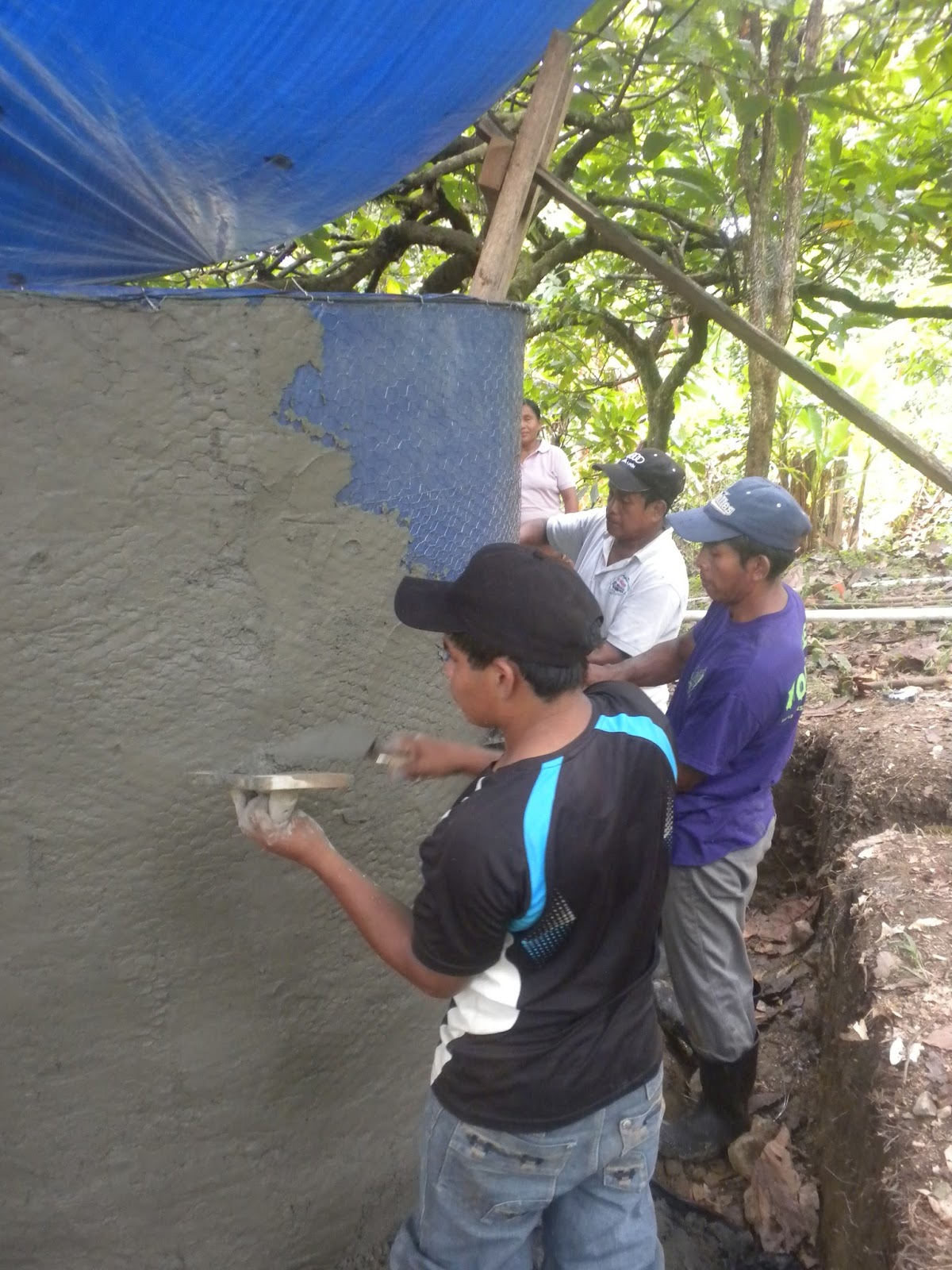
 Father and son working together plastering the inside of the tank


Preparing the tank roof


A little helper taking refuge from the rainy afternoon


Another little helper, taking a break


Nayelis climbing out of the almost-completed tank


Nothing heals a rough day like baby kitties – born at the meeting place of the Santos aqueduct, where momma-cat reluctantly lets me borrow them for a few minutes


Monday, March 14, 2016

Magic

Back in January, as I was waiting for my Water Committees to get organized and ready to buy materials and start our aqueduct projects, I was granted a few precious days that I could sit and read in my hammock for hours on end.  I became totally immersed in a fantasy trilogy called Name of the Wind.  I knew I should have been preparing for the project – reviewing my designs, organizing my materials lists – but every time I started feeling guilty about it, I dove back into the books in procrastination, driving away any feelings with my immersion in the story, in an endless cycle.  Turns out a central concept in the book was a fitting foreshadowing of the looming project.

An excerpt:

“What will happen if I let go of this rock?”
“It will probably fall.”
“Probably?  Hasn’t it always fallen before?”
“Don’t try to boldface your way through this one.  That’s a fallacy.  You taught me that yourself.”
“Fine.  Would it be fair to say you believe it will fall?”
“Fair enough.”
“I want you to believe it will fall up when I let go of it.”
I tried and I tried.  It was the most difficult thing I had ever done.  It took me almost all afternoon.
Finally Ben was able to drop the rock and I retained my firm belief that it wouldn’t fall despite evidence to the contrary.
“I want you to believe the rock will fall and that the rock will not fall when I let go of it.”  He grinned.

I went to bed late that night.  I had a nosebleed and a smile of satisfaction.  I held the two separate beliefs loosely in my mind and let their singing discord lull me into senselessness.

Being able to think about two disparate things at once, aside from being wonderfully efficient, was roughly akin to being able to sing harmony with yourself.

Patrick Rothfuss, The Name of the Wind

I believe I will succeed.  I believe I will fail.  In fact, I know both of these, with certainty.  Just like in this novel, in which all magic in this world of fantasy is based on this ability to hold two opposing beliefs at the same time, the magic of my service also comes from this ability.

My Mom always expressed this sentiment as, “Prepare for the worse, hope for the best” which is just the pragmatic approach necessary to get things done while guarding against the emotional roller coaster that always accompanies things we care about.

Every day that I go into this aqueduct construction project, I am afraid that I am making mistakes.  Is this tank going to hold water?  Will there be sufficient pressure in all the houses?  Did I do my calculations right?  Was my surveying done well enough?  Is there going to be enough water when the flow is low?  Is the Water Committee going to be able to manage the aqueduct and the funds and issues with the users?  Is anyone actually going to chlorinate the water in their houses?  Are there going to be feuds with the neighbors?  Have I anticipated all the potential problems and prepared them for it?

Yet I go on believing that it will somehow all work out, even without having the evidence, for the sake of seeing through the project instead of succumbing to the paralysis of perfectionism.

Knowing that in some ways the project will be a success regardless – the people will indeed have more access to water in their houses, and the experience of organization and working together to achieve this improvement is indeed empowering for these families – while at the same time knowing that in some ways it will also be a failure – they may not see health improvements if they don’t follow my suggestions for proper water treatment and storage and handwashing; someday things will break and I can’t know if they are going to have the money, knowledge, and motivation to fix it; I can’t be sure that they will see this project as empowering instead of yet another example of needing the help of outsiders – this is the magic of maintaining those conflicting beliefs and moving forward with the ambition to do it anyway.

We may not have in our world the Harry Potter magic that makes reading fantasy books so fun – but there is a real magic in this world that is even more powerful – the magic of hope that acknowledges failure, of believing absolutely in both the ambition and its futility, then acting for the best anyway.  I practice magic every day.

Pictures:

Working on the Santos Aqueduct

Finishing up the second intake structure


Taking a moment to play with tadpoles


Working on the Beker Aqueduct

Making formwork for a splitter box (to divide the water fairly)


Ferrocement storage tank construction –


Getting the ladies involved after lunch – making steps for the permanent ladder inside the tank


Setting up the form for the tank


Plastering and reinforcing the tank


Working on the roof


Working from inside the tank


How I feel at the end of each day