Saturday, January 16, 2016

Graduation

I have not had much time to write -- busy getting ready to purchase materials to finally begin the construction of the two small aqueduct projects we've been working toward -- so just a few pictures from the last few weeks:

I got to be part of all kinds of graduations!

Graduation from 9th grade – “first cycle high school” – in Quebrada Pastor


And graduation from 12th grade – “second cycle high school” – in Almirante – in which you specialize in an area and earn a degree (I understand grades 10-12 here to be worth something like our equivalent of a 2-year college) -- I got to attend two of these, and one party afterward


Another part of the end-of-the-year celebrations: killing and butchering a cow at Ema's house.  Thankfully, I did not have to help (or observe anything except for the aftermath).  Look at the brain!!  (Apparently it makes a tasty gelatinous soup.  No thanks.)


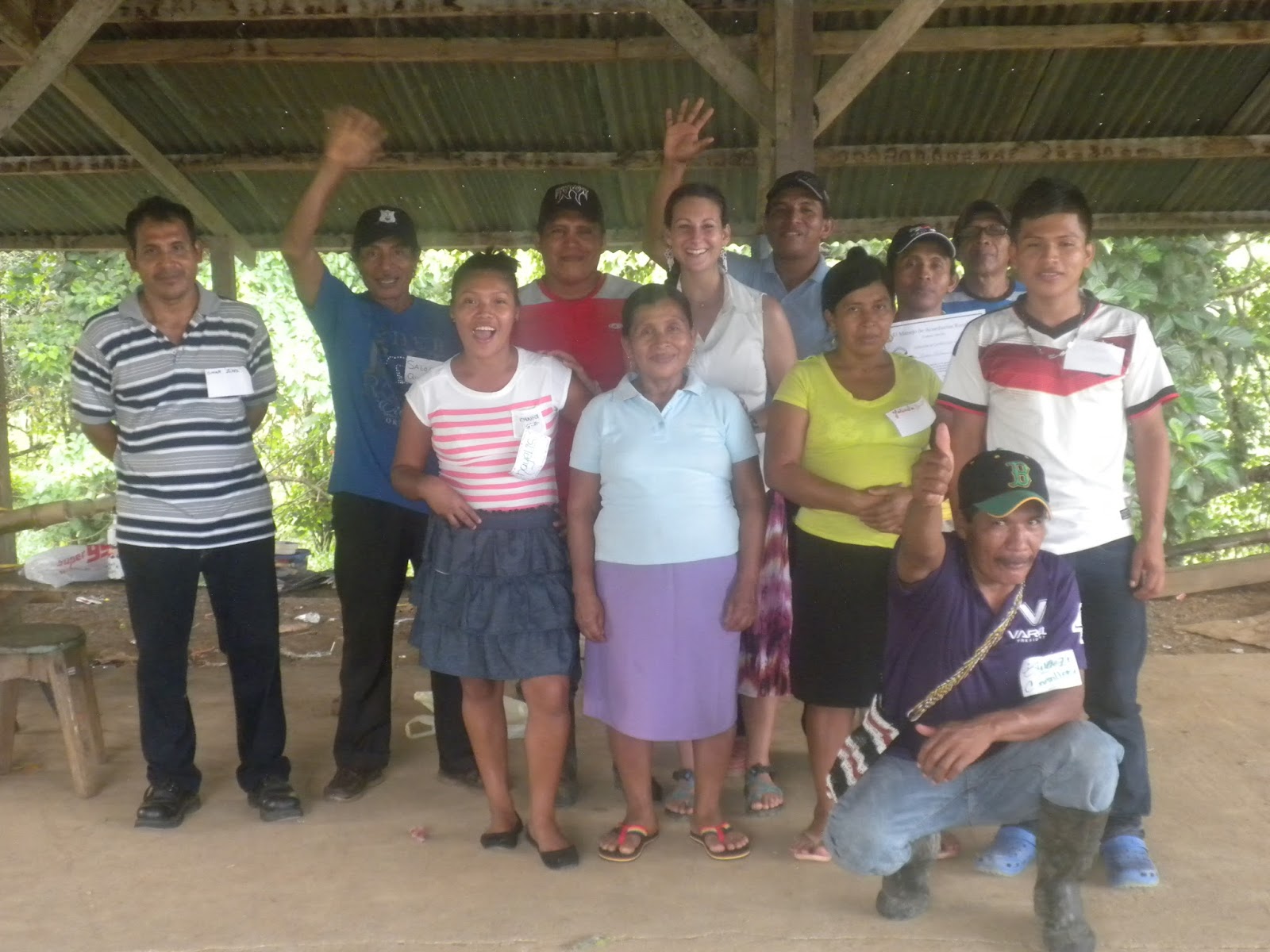
And graduation from the Water Committee Seminar!  Collectively, over the course of 6 sessions, all the participants gained 462 hours of training.  The two Water Committees that were required to attend had 182 and 133 collective hours of training respectively.  Lots of help from other Volunteers to make that happen!


We all graduated 2015 and got to move on to 2016!  Big party at my house to welcome the New Year.


Elena and Matt came to visit me – which had to include a Chocolate Tour with Willy and family.  Elena “graduated” the tour with new skills in cacao harvesting and chocolate production.


We made it to the top of Volcán Barú, the highest point in Panamá (took us 7 hours to get up there, racing the sunrise)!  There’s a graduation with a reward!  View of both oceans and pretty much the whole country.  


Pretty sure Quebrada Pastor is right… about… there…


Thursday, December 17, 2015

Cultural Collision

A Campo Christmas parade.  And the best parade I’ve seen in Panamá.  In a little community called Odobate, rising out of the wetlands in the middle of the wet and steamy jungle of the Bocas side of the Comarca (reservation for the Ngöbe people).

The band was small, with only half a dozen drums (which was pleasant on the ears compared to other parades this year), a handful of baton twirlers and dancers, and a single girl with a one-handed bell kit (lira).  They left the school in their little line at dusk, walking around the field in front.  Each had a light-up Santa hat that twinkled in the dim light.  A fully-costumed Ngöbe Santa Claus (about 5 feet tall) led the way.

We visitors walked alongside the parade, jumping in and out to take pictures with the performers and, of course, with Santa.  And at the end, as the procession wound its way through the dark back to the school, the drums stopped.  To our surprise, the one lone little bell kit started playing “Jingle Bells,” one note at a time, out into the night.

The single notes of Jingle Bells were the only sound we could hear.  All we could see were the Santa hats lighting up in a little line curving through the dark.  Out in the middle of nowhere.  It was magical.

The first week of December, Ángel, Katy (a fellow Volunteer), and I made the voyage to the community of Odobate, the site of Mary Catherine, another Volunteer.  And it was indeed a voyage – a sea journey across the Chiriquí Lagoon, followed by Amazonian-style boat ride upriver through the jungle, followed by a nearly two-hour hike through wetlands and enchanted forest over hundreds of logs laid end-to-end like an endless balance beam.  Nothing could be more different than the voyage to Quebrada Pastor – stepping off a giant coach bus (sometimes) right into my front yard.

Ángel joined us at both the expressed wish of the Water Committee president of Odobate (they met each other during the Project Management and Leadership Conference in May) and his own expressed desire to visit.  His role was to help motivate the Water Committee to renew their work with their Volunteer in making improvements to their aqueduct and provide mentorship to a community that is having its very first experience with Peace Corps – a role that he relished and performed masterfully.

But his role was also what Volunteers have taken to calling Peace Corps’ “4th goal.”  (1st goal – provide technical assistance in specified field, 2nd goal – teach host country about the US, 3rd goal – teach Americans about host country.)  4th goal – teach Panamanians about other Panamanians.

Ángel has always lived in Quebrada Pastor.  He has traveled some to other communities, some of which are pretty distant and isolated.  But never to a place like Odobate.  When he learned that over the last year, 8 babies have died there (some of water-borne illness), he was shocked and disturbed (as was I).  And he wanted to do what he could to help – which in this case, was encourage the community leaders to make use of their Peace Corps Volunteer, a valuable resource in improving environmental health.

Actually, Ángel would make a great Peace Corps Volunteer himself.

And really, that’s kind of the point.  As I think about my time here coming to a close, the best thing I can do to ensure the sustainability to my work, to continue moving Quebrada Pastor forward in terms of improving its environmental health, is to train its leaders to do my work.  Give them all the tools they need to continue training other people.

I just hope that all of the work that I do – teaching people to build tanks and latrines, holding 50-hours-worth of Water Committee Seminars to train old and new Water Committees everything there is to know about running an aqueduct, asking community leaders to help me with training activities, community organization tasks, and all the studies and surveys and investigations – is training the next set of teachers, the people who will take over this work when I leave.

Like Jingle Bells in the night, if I actually get to see that happen, it will feel a little bit like magic.

Pictures:

Taking advantage of a pretty day to refresh my perspective of Quebrada Pastor.  Still a pretty place, no matter how you look at it.


Another day of Water Committee Seminar – teaching how to thermoform pipe, solve technical problems, and resolve conflicts.  I managed to break the ice pretty effectively by completely failing at my first attempt at thermoforming – producing a work of art instead.


Our dedicated cooks take a little break across the street prior to coffee time.


Hanukah with Hobbes!


Friday, December 4, 2015

Thanksgiving

In elementary school, growing up in Massachusetts, we would celebrate Thanksgiving in the classroom by dividing up the class – half wearing construction-paper hats and half wearing construction-paper feathers – and sitting all around a big table made of all the desks pushed together, to share a meal as “Pilgrims and Native Americans.”

In school we talked about how the Pilgrims were about to starve to death that first winter in America and only survived thanks to the help of the Native Americans, hence our celebration of Thanksgiving.

Of course, being in first grade, we didn’t really talk about how the Pilgrims ended up giving the Native Americans smallpox, which killed most of them.

How strange, then, ironic perhaps, to be celebrating Thanksgiving with an indigenous community in Panamá, especially since the people of Quebrada Pastor took me in as an outsider, taught me how to live here, and were responsible for feeding me for the first three months.  Although, in a new twist, I was more concerned about tropical diseases than they were about smallpox, and my work here revolves around teaching how to reduce water-borne illness so that children grow up healthier.

However, the way my family always celebrates Thanksgiving in the US doesn’t really address any of that.  As with all holidays, we made it our own – the important thing to us was to reflect on what we are thankful for in our lives.  This tradition was carried on here in Panamá among the Volunteers celebrating with me.  But instead of just sharing one thing for which we are thankful, we shared with respect to all three of our lives – our lives within our communities, our lives within the Volunteer network, and the lives we left – but are still linked to – in the US.

I said that I was thankful to have such dedicated community leaders working with me, especially, of course, Ángel; that I was thankful for the network of Volunteers that will always understand this experience better than anyone else and that I can continue to be part of after I leave Panamá; and that I was thankful for the wholesale, unwavering support of my family and friends because that made being here possible in the first place.

And I am also grateful that the US government affords me this opportunity and that I have the privilege to choose my field of work, including the privilege to choose to be here.  Living in Quebrada Pastor has helped me be so much more grateful for the things I easily took for granted before.

I am grateful to have had a quality primary, secondary, university, and graduate education – the first two of which were guaranteed to me, the second two of which I can thank my parents for supporting.  My teachers showed up every day of the school week for the entire school day.  I did not have to walk an hour of more to school, crossing streams that got dangerous when it rained.  My education was rich with creativity and self-exploration and hands-on learning and critical thinking and analytical skills.  My parents gave me full support, could buy me all the tools I needed, could help me with my homework, took me to museums, bought me books and read them to me and with me even before I started school, encouraged all of my learning and supported each of my interests.  All of that makes me incredibly fortunate – and completely unusual here, such is the extent of my privilege.

I also grew up knowing that I could pursue whatever career I wants – and that being a girl did not diminish my choices – my Mom was adamant about this.  That it was not automatically my job to raise kids and take care of housework – that I could choose, that housework should be shared, that I could focus on my education and growing up and having a career before thinking about having a family, that men and women should be equal partners and equal decision-makers in a relationship.  I took all this for ranted but realize that not everyone does.  These are not automatic assumptions in Quebrada Pastor; when I see and hear people express this view, it comes as a pleasant surprise rather than the norm.

Yet people here are still thankful for what they have – for their families, who live close and are available to support them, for their fertile land and ample rain that allows them to grow food and cacao all year long – which inspires me to be thankful for the blessings of family and of nature as well.

So I sit around the table of my Quebrada Pastor family, eating the “Glorified Rice” that is my Mom’s family tradition, looking over the verdant Bocas islands shimmering under a bright blue sky, marveling at this opportunity to see with renewed insight the good fortune I have been given.

Pictures:

Glorified Rice – the dish that makes an appearance at all of our family holidays, and that on any Thanksgiving, Christimas, or Easter I know someone, somewhere, on my Mom’s side of the family, is also eating.


Homemade hot sauce – my host family gave me my own bottle – add three drops to your meal and your nose will run.


Food to celebrate Willy's birthday – which we happened to celebrate on Thanksgiving, two events for the price of one – home-raised chicken with rice, boiled green bananas, and daishin (a root vegetable)-and-egg salad.


Heidy, happy with her food.


Eating Willy’s birthday-cake-brownie that I made for the occasion.


Glorified Rice – glorious in every culture!


Heidy in the Independence (from Spain) Day parade in Almirante with the Quebrada Pastor band, a couple days after Thanksgiving.


Tuesday, November 17, 2015

People are People

The longer I am here, the more I am reminded that, in the end, people are people.  We may have cultural differences, different ways of doing things, different means, different ways of expressing ourselves – but we are overwhelmingly alike.  I think this is one of the primary lessons of being a Peace Corps Volunteer – or any experience that immerses you in a foreign context.

In the beginning, first arriving in Quebrada Pastor, I would often complain with other Volunteers about the quirks and challenging of living in a Ngöbe community.  But now, having adjusted to the superficial things (like the food we eat, differences in language, emotional expression), and being able to pick about the differences based on context, opportunity, and privilege (like education, exposure to other people, ability to travel, abundance of choice, managing money, perspective and understanding of health, handling unpredictability) – in the end, a lot of the challenges and issues that we face are universal.  So many of these obstacles to my work here are just people issues.

There is the same kind of range in personalities, in attitudes, in values, and in abilities in this community as there is in any other.  Same characters, different context.  Some people are leaders, some people are responsible and dependable and honor their commitments.  Some people care about the greater good, take an interest in the outside world, are always helping others, and share what they have.  Some people love being the center of attention.  Some people love taking all the credit.  Some people only look out for themselves and their closest kin.  Some people are always in squabbles with others, always causing drama.  Some people never show up when they say they are going to, even if they are really fun to be around and want to like them.  Some people wait and watch and won’t participate until someone else is courageous enough to make the first move to act.  Some people are noisy obnoxious neighbors.  Lots of people look to blame someone else and won’t take responsibility for things going wrong.  Or won’t even put themselves in a position of responsibility in the first place.  And everybody likes getting free stuff.

That all sounds like people I’ve known all my life.  And so the things that are most frustrating are the same frustrations as always.

But I do enjoy the unique position here of being able to experience and observe all of this, partly as an insider and partly as an outsider.  And it is basically my job to figure out how to deal with all these different types of people.  And the context is different enough that I actually have to think carefully about whether someone’s behavior reflects a cultural difference, a difference in context, or just their personality.

I’ve been holding a Water Committee Seminar almost every weekend since I got back from America.  The primary purpose of the Seminar is to teach good aqueduct management, to build capacity within the new Water Committees that have been formed in anticipation of the aqueduct project for which I have applied for funding (we hope to build two separate aqueducts – one to serve the 7 houses of the Santos family – Ángel’s family – and one for the 15 houses of the Beker family, on a different hill).  The Seminar covers the basic connection between water and health (like the importance of good water storage and treatment) how to manage a Water Committee (running good meetings, working as a team, managing funds), and how to maintain and operate an aqueduct (the technical details).  So far we’re just over halfway done.

I also invited the other four existing Water Committees in the hope that they can help teach the new Committees about their successes and failures and offer the opportunity to increase their own capacity.  One Committee – the best-managed one in the community, from what I can tell – has been regularly attending and proved useful in this.

I was really hoping that the Water Committee for the school-and-center-of-town aqueduct would also attend.  I have been wanting, since my arrival, to improve the functioning of their Committee.  Especially now, as we anticipate making some physical improvements to the system during school vacation, this seems like a good idea.  However, no one has yet attended a session.

One of the most striking areas for improvement in this particular Committee is exactly what we talked about in the last two days of the Seminar – working together productively as a team.  Meetings are often poorly run, work days are filled with interpersonal conflict, and when people see the lack of participation and motivation of others, it further demotivates everyone’s sense of responsibility.  Everyone just complains about everyone else shirking on their jobs and shifts blame to someone else.  No one wants to be on the Committee because it is such a thankless job.

And yet, this is the aqueduct that supplies both the school of 300 students and 30 houses with water, which has existed since 2002 when the government built it.  Somehow the Water Committee has been able to keep it running this long, which is actually quite impressive.  Once in a while, somebody probably ought to recognize them for that.  And, after all, it is important work: the students need water during the day at school, so everyone in the community – not just the homeowners who are also users – depends on the function of this aqueduct.  And everyone agrees that it’s important.

If only the members of the Water Committee had been attending the Seminar.  We could have talked about all of that.  We could have talked about the importance of positive communication, how providing positive feedback and reinforcement an appreciation can motivate people to keep working in their positions, to take pride in their responsibilities.  How having a well-run meeting means that no one will be wasting their time, so meetings do not have to be a dreaded thing to be avoided.  How rules and agendas make that easier and more possible to achieve.  How everyone needs to play their role on the team to share the load and solve complex problems, how no one can do it alone, but everyone working together make it possible.  If only they were willing to talk about these things.

And then I realize that, even though these seem like really simple and obvious solutions, these kinds of problems – lack of responsibility, wasting time, weak motivation – plague organizations and places of work everywhere, for the same reasons.  People are people, after all.  But people are also capable of fixing these things, with a bit of effort and a bit of desire.  I haven’t given up hope on my people yet.

Pictures:

It’s Panamanian holiday month!  Starting off with Independence from Colombia day, with a parade down the highway through Quebrada Pastor.


Visit to Renacimiento, the neighboring community, to spend Flag Day with Chelsea, my new closest Volunteer.  Apparently one of the traditions is oiling up a smoothed-down bark-less tree and telling the kids if they can get to the top they can keep the money in the bag up there.

Just another gorgeous day.  Thanks to El Niño (I’ve been told), it has been unusually and unseasonably dry in the Bocas del Toro province – several weeks now with little rain (when we are used to it raining at least every three days).  It’s been so dry that the mud has all but disappeared – once you start seeing cracks in the earth, you know the weather is being weird.


Water Committee Seminar – giving presentations about the importance of the protecting the watershed, thinking about how we work based on our values, and playing a teamwork-themed icebreaker.


New Adventures!  Gorgeous hike through the jungle 3 hours to Quebrada Pueblo, home of new Environmental Health Volunteer Saswe, to do a safety inspection on her new house.


Attending the Bocas Day parade with the family, and a trip to the beach!


Birthday party at Ema’s house – brought my nagua so that I would fit in with the rest of the ladies.